
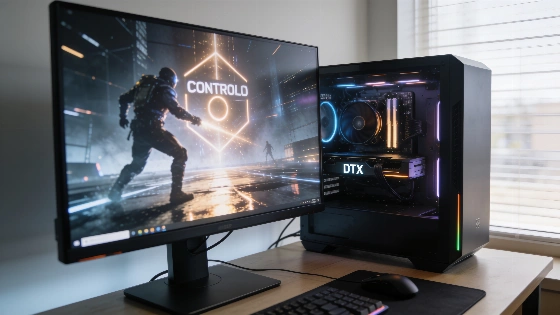
Remedy has published the full PC requirements for CONTROL Resonant with an RTX 5080 needed for path tracing at 2160p but a GTX 1070 still listed as the minimum. The specs reveal a sharp divide between high-end ambitions and broad accessibility
Remedy Entertainment has set a new technical bar for CONTROL Resonant on PC, officially listing the NVIDIA GeForce RTX 5080 as the required GPU for path tracing at 2160p. This is the first time a mainstream game has openly targeted such a high-end graphics card for a single visual mode, making it clear that the studio is pushing its Northlight Engine to the limits for those seeking the most advanced lighting and reflections available.
PC Requirements Breakdown
The published specifications cover a wide range of hardware, from the modest NVIDIA GeForce GTX 1070 at the minimum to the RTX 5080 at the top end. Remedy has detailed six distinct presets: Minimum, Recommended, Enthusiast, Ray Tracing Minimum, Ray Tracing Recommended, and Path Tracing Enthusiast. Each preset specifies resolution, target frame rate, upscaling mode, graphics settings, and the necessary GPU, VRAM, CPU, and RAM.
For standard gameplay at 1080p and 30 frames per second, the minimum requirement is a GTX 1070, AMD Radeon RX 5600 XT, or Intel Arc A580, paired with an Intel Core i5-8500 or AMD Ryzen 5 3500 and 16GB RAM. At the other extreme, the Path Tracing Enthusiast preset calls for an RTX 5080, 12GB VRAM, and an Intel Core i7-10700 or AMD Ryzen 7 3700X, targeting 2160p at 60 frames per second with performance upscaling and the highest graphics and ray tracing settings enabled.
Feature Set and Engine Technology
CONTROL Resonant is built on Remedy's proprietary Northlight Engine, which has powered all of the studio's recent releases. The PC version supports uncapped frame rates, NVIDIA DLSS 4.5, AMD FSR 4.1, frame generation, ray tracing, and full path tracing. Storage requirements are set at 120GB on an SSD, and the game runs on Windows 10 or 11 64-bit. The inclusion of both DLSS and FSR means players with a wide range of hardware can benefit from upscaling and frame generation, though the most advanced visual features are reserved for the latest GPUs.
Ray tracing is available in two tiers: a minimum setting that requires an RTX 2060 SUPER or equivalent, and a recommended setting that jumps to an RTX 4070 Ti or AMD Radeon RX 9070. Path tracing, which simulates global illumination and complex lighting effects, is only available at the highest preset and demands the RTX 5080. Remedy's approach signals a willingness to embrace the bleeding edge of PC graphics, but without abandoning players on older hardware.
Performance Targets and Player Impact
The requirements make a sharp distinction between visual ambition and accessibility. While the RTX 5080 is needed for path tracing at 4K, the game remains playable on much older cards at lower settings. The minimum spec targets 1080p at 30fps on low settings, while recommended and enthusiast presets scale up to 1440p and 2160p at 60fps with higher graphical fidelity. Upscaling modes-Quality, Balanced, and Performance-are used throughout to help reach these targets, reflecting the industry's increasing reliance on AI-driven image reconstruction to deliver high resolutions without overwhelming hardware.
Remedy's decision to publish such a broad spectrum of requirements is a practical move. It sets clear expectations for players with both legacy and cutting-edge systems, and avoids the confusion that often follows when only minimum and recommended specs are provided. The explicit callout of path tracing as a separate, ultra-demanding mode also prevents unrealistic expectations about what most PCs can deliver.
What Remains Unclear
Despite the detailed requirements, several questions remain. Remedy has not yet released independent performance benchmarks, so it is not known how stable frame rates will be across the full range of hardware in real-world scenarios. The RTX 5080 requirement for path tracing at 2160p is based on target performance, but actual results may vary depending on scene complexity and driver support at launch. It is also unclear whether the listed CPUs will be a bottleneck at higher settings, or if additional optimisation patches are planned post-release.
With the game's launch just weeks away, the absence of hands-on public testing means players will need to wait for independent reviews to verify how well CONTROL Resonant scales across different configurations. Remedy's transparency about the hardware needed for its most ambitious features is welcome, but the real test will come when the game is in players' hands and the claims are measured outside controlled environments. For now, the message is clear: CONTROL Resonant is designed to showcase the latest in PC graphics, but it is not leaving older systems behind.
Path tracing is a rendering technique that simulates the way light bounces and interacts with surfaces to produce highly realistic lighting, shadows, and reflections. Unlike traditional rasterisation or even standard ray tracing, path tracing calculates the full path of light rays as they travel through a scene, resulting in more accurate global illumination and subtle visual effects. However, this process is extremely demanding on hardware, which is why only the most powerful GPUs can deliver smooth performance at high resolutions. Upscaling technologies like DLSS and FSR help mitigate the performance cost by reconstructing higher-resolution images from lower-resolution inputs, allowing players to experience advanced lighting effects without sacrificing frame rate.