
Cold Iron Studios expands its alien-slaying co-op shooter with new classes, weapons and missions, but repetitive encounters and weak AI make Horde mode the stronger long-term draw.
A Smartgun burst can hit a xenomorph without causing much of a reaction. That problem shapes Aliens: Fireteam Elite 2, where the best fights come from holding a position with friends rather than chasing enemies through the campaign.
The sequel launched worldwide on August 25, 2026, for PC through Steam and the Epic Games Store, PlayStation 5 and Xbox Series X|S. Cold Iron Studios developed the game. Daybreak Game Company published it in cooperation with 20th Century Games, the rights holder of the Alien film franchise. Corporate data cited by Simply Wall St puts development spending at 356.3 million Swedish kronor. A Nintendo Switch 2 version was first scheduled for September 29, 2026, but Cold Iron Studios pushed it to early 2027 for more platform-specific polishing, OpenCritic reported.
A broader fireteam
The sequel keeps the established structure. Players choose a class, then enter linear campaign missions built around finding survivors and cutting through repeated alien attacks. The story starts as a search-and-rescue operation before widening into a planet-wide hunt for a rogue Weyland-Yutani scientist. She believes she can control the xenomorph threat. Rescuing members of the USS Endeavor gradually brings the fireteam closer to her and to the mystery behind her disfigured face.
Most classes are available from the start. The Specialist unlocks later, after players spend enough time with at least two other classes. Each role has a signature weapon, active abilities and passive abilities. Weapon familiarity also feeds progression. Spend enough time with a gun and players can carry it across other classes. The Specialist is the oddest addition because its passive options are supplemented by abilities unlocked through other roles.
That setup gives players a better reason to try different loadouts than the original framework did. Class and weapon progression work together, so changing roles does not mean giving up a favourite gun. The system is practical rather than transformative, but co-op groups have more room to build fireteams that cover each other's weaknesses.
The four-player limit is a real expansion of the series' original co-op setup. Game Informer reports that the sequel supports squads of up to four players on PC, PlayStation 5 and Xbox Series X|S. The larger fireteam now sits at the centre of its tactics and matchmaking.
Firepower under pressure
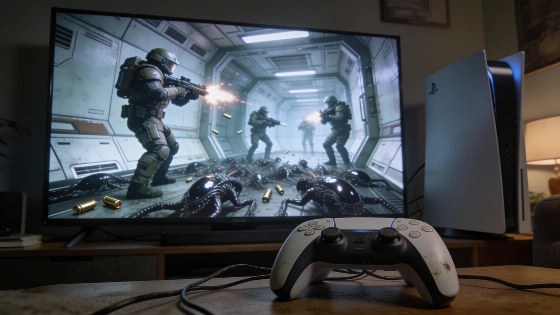
Combat remains the game's biggest problem. Xenomorphs can absorb direct hits from a Smartgun or other ballistic weapons with barely any visible reaction. Larger waves turn that bullet sponge behaviour into an ammunition test instead of a marksmanship test. Long stretches can leave a squad short on ammunition, so the sidearm with unlimited backup ammunition and timed class abilities become important safety nets.
Melee attacks share stamina with defensive dodge rolls. That makes them a poor choice when survival depends on avoiding incoming damage. The weapon roster is otherwise broad, with franchise staples such as pulse rifles and smartguns alongside less familiar choices, including a portable railgun. Players can buy weapons with credits or unlock them through class ranks, then improve each one through four upgrade levels.
Those levels add a passive trait unique to the gun, a new colourway, cross-class access and a Prestige slot for endgame passive abilities. The rewards give players a reason to keep using individual weapons. Progression can still feel slow when the combat asks squads to burn through large amounts of ammunition against enemies that barely react to impact.
Friends beat automation
The campaign is built for a four-player squad, and the replacement AI shows why. Solo players get generic automatons, but those companions lack the synergy and timely ability use of human partners. A teammate carrying a spare ammo pack can decide whether a defensive position holds or the whole squad gets overwhelmed.
Drop-in and drop-out co-op is not supported. Players can reconnect after a disconnection or host migration, and a missing human is replaced immediately by an AI companion. These systems keep a disrupted session moving, but they do not fix the main weakness: Fireteam Elite 2 depends far more on coordinated players than its solo option suggests.
The campaign's size looks substantial on paper. It contains roughly eighteen missions, supports up to four players in its intended fireteam and offers four upgrade levels for every weapon. The review was conducted on PlayStation 5 Pro with review code supplied by the publisher. No frame-rate measurements or resolution figures were provided, so this assessment covers gameplay structure and combat behaviour rather than performance testing.
Scripts limit replay value
Cold Iron Studios gives the missions distinct locations and enemy arrangements that fit the Alien world established by the original trilogy and later Aliens titles. The weakness appears on repeat runs at higher difficulty or with a different group. Enemy waves keep emerging from the same locations in similar numbers, and recurring one-liners wear down the tension of set pieces.
That predictability matters because the campaign follows a linear path. Once players know where an Alien will break through or when a boss is about to arrive, much of the suspense disappears. More varied encounters could have strengthened repeat runs. Instead, the game pushes long-term players toward Horde mode, where testing new classes and weapon combinations has a clearer purpose.
Horde mode is more than a post-game extra. It is where the progression systems make the most sense, since every new unlock can be tested against rising waves and the changing needs of a fireteam. The campaign works as a one-off co-op run for players who like the setting, but its scripted structure gives them little reason to return to the same missions.
Scripted encounters place enemy spawns, dialogue cues and major attacks at set points instead of generating them dynamically. That approach can create carefully timed set pieces on a first run. Repetition makes the limits clear because players learn each trigger point. Randomised enemy locations or wider encounter variation would not solve every combat issue, but they would give experienced squads more chances to be caught off guard.
Aliens: Fireteam Elite 2 improves the original formula without fixing its most persistent friction points. It is a decent Aliens shooter and a serviceable co-op campaign, but its strongest form is a group of friends refining class and weapon synergy in Horde mode. Better weapon impact, stronger solo AI and more flexible encounters could have moved it beyond that narrow recommendation. In this review, it is worth considering for dedicated horde-shooter fans, not for players seeking a campaign that stays suspenseful on repeat runs.