
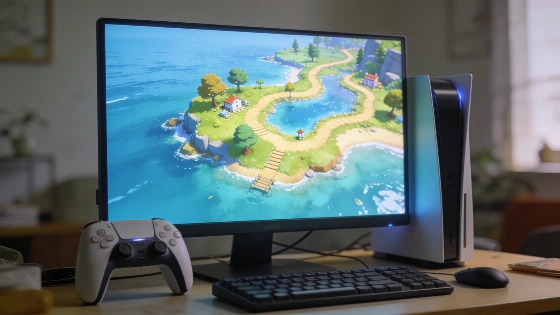
A beta recompilation brings the 2019 Switch game to desktop systems, with ultrawide support and an experimental randomizer. Its creator says AI produced nearly all the underlying work under human direction.
Players need their own dump of the purchased game to use LAS Recomp. Windows is supported.
The unofficial project appeared in 2026 and turns the 2019 Nintendo Switch release of The Legend of Zelda: Link's Awakening into a native PC application. Its creator, Peiikai, says AI handled nearly all of the code. It also produced the tools, reverse-engineering work and documentation. Peiikai directed the project, then tested and reviewed the work.
A different route to PC
LAS Recomp uses static recompilation of Switch code rather than emulation, according to its project description on GitHub. The project translates the game's code to run as a native application, instead of running it inside a simulated Switch environment. Recent PC work has also included an emulation-based Bloodborne graphics experiment. LAS Recomp takes a different technical route.
Players seeking the original Switch system fonts must extract them from their own hardware and provide them to the project. Replacement fonts are used by default. The port also runs on macOS.
The in-game overlay opens with F1 or by pressing the Minus and Plus buttons together on a controller. The original 16:9 view remains available as an option. Linux is supported too.
More room to explore
The port can reveal more of the island in wider or taller windows, including on ultrawide displays, while keeping houses and dungeons within their original framing. Players can adjust the internal resolution or use dynamic resolution. Apple MetalFX upscaling is the default on macOS. Windows currently offers bilinear upscaling only.
Players can use a keyboard or controller, and remap every key and button. Prompt choices include Xbox and PlayStation styles. Nintendo prompts are available too. The port supports 360-degree movement and blur removal, alongside its in-game overlay. These features do not establish how well the game runs: the project supplies no benchmark results, so claims that it suits lower-powered hardware remain unverified.
The experimental randomizer makes the biggest changes to the game itself. It can shuffle items. Weapons and keys can move too. Enemies can be reshuffled, as can shop contents. The trade quest and music can change, while dungeon rooms can be rearranged. Players can switch between the regular game and randomizer without restarting.
DSOGaming warns that some randomizer seeds may be unsolvable. Shuffling dungeon rooms is especially experimental. The feature offers another way to replay the game, but its beta status means it is not a polished alternative campaign.
AI with human oversight
Peiikai says Anthropic's Claude, used through Claude Code, wrote nearly all of the repository's code. The AI also produced its tools and reverse-engineering work, along with the documentation. Peiikai said the project was beyond their original skill set without AI. A human still directed the work, tested it and reviewed the results. The AI-assisted process reached beyond application code into the technical analysis behind the recompilation.
LAS Recomp is unofficial and is not a Nintendo product or an official PC release. Users must supply their own game files. The project is distributed as a beta, with possible bugs. Crashes and visual glitches may also occur, and some randomizer combinations may be impossible to complete.
Static recompilation translates a programme's code for another platform ahead of execution, rather than reproducing the original hardware environment through emulation. A native application can use platform-specific features. The label alone does not establish better performance. It also says nothing about perfect compatibility or legal permission. Those questions are separate from the port's stated method and features.