

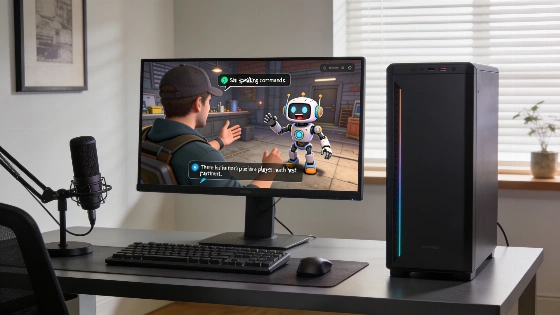
Meant Well Games has revealed Voice Heist, a first-person comedy action game for PC where players issue spoken commands to an AI-driven robot partner, with all processing handled locally on the player's machine
Meant Well Games, a Dublin-based independent studio, has officially announced Voice Heist, a first-person comedy action game built around voice commands and on-device artificial intelligence. Scheduled for release on PC in 2027, Voice Heist puts players in the role of a criminal mastermind who must direct a robot accomplice using spoken instructions. The game's central mechanic is the gap between what the player intends and how the AI-controlled robot interprets those orders, with every action in the game triggered by the player's voice or text input.
Gameplay and AI Integration
Voice Heist is designed around a partnership between the player and an AI-driven robot, with the player acting as the brains and the robot as the hands. All commands are issued verbally or via text, and the robot's responses are powered by a language model running locally on the player's hardware. This approach means the robot can react to the environment, comment on player decisions, and answer questions in real time, without relying on cloud processing or external servers. The AI does not generate new behaviours on the fly; instead, it selects from a set of pre-authored outcomes-both correct and intentionally comical mistakes-crafted and animated by the development team.
Players can choose different approaches to each level, such as breaking in through a window, picking locks, disabling cameras, or simply grabbing whatever they can. The game avoids dead ends by ensuring that a failed approach closes off a route rather than ending the run entirely. Mistakes made through misunderstood commands increase an in-game alarm meter, which in turn affects the robot's behaviour and adds pressure as the level progresses.
Technical Approach and Privacy
Voice Heist is built using the Tryll Engine, which enables all AI processing-including speech recognition, language modelling, and speech synthesis-to run directly on the player's PC. This design eliminates network latency, avoids per-message costs, and ensures that no voice data leaves the player's machine. The language model is intentionally kept small and is restricted to selecting from a closed set of developer-authored actions, rather than inventing new behaviours or dialogue. This approach is intended to maintain both player privacy and creative control over the game's comedic tone.
Text input is also supported throughout, allowing players without a microphone to experience the full game. The studio emphasises that all art, design, and comedic writing are created by humans, with the AI serving as a performer rather than a content generator.
Release Timing and Studio Background
Voice Heist is currently planned for release on PC in 2027. Meant Well Games is a four-person team based in Dublin, focusing on games where artificial intelligence is integrated into gameplay rather than content production. The studio's philosophy is to use AI to enable more responsive and interactive characters, while keeping creative authorship firmly in human hands. Tryll Engine, the technology partner for Voice Heist, specialises in on-device AI solutions for games and has previously received support through Epic MegaGrants.
The announcement was accompanied by a teaser trailer, which is available on YouTube. No information has yet been provided regarding pricing, additional platforms, or early access plans. The game remains in active development, with further details expected as the release window approaches.
On-device artificial intelligence refers to AI models and processing that run entirely on the user's hardware, rather than relying on cloud servers or external data centres. In the context of Voice Heist, this means all speech recognition, language understanding, and response generation happen locally, reducing latency and keeping player data private. This approach contrasts with cloud-based AI, which can introduce delays and privacy concerns but may allow for larger or more complex models. By limiting the AI to a closed set of developer-authored outcomes, Voice Heist aims to balance technical feasibility, creative intent, and player trust.