
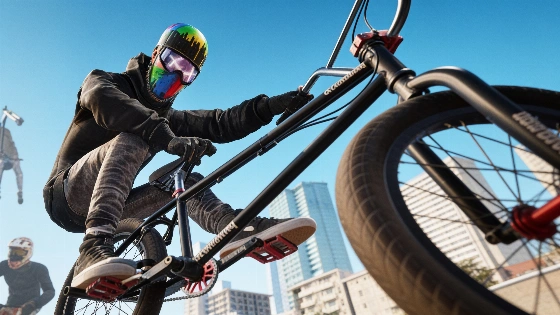
Break Free Interactive has released VMX on Meta Quest 2 and Quest 3 for $14.99 / £11.99 / €13.99. The VR sports game uses gesture-based tricks across five riding locations and multiplayer sessions.
VMX is now available on Meta Quest 2 and Quest 3. Its pitch is simple: replace button combinations with physical movement across BMX bikes, mountain bikes and scooters. Break Free Interactive's debut game launched on October 2 2026 for $14.99 / £11.99 / €13.99. It puts riding physics, gesture-based tricks and multiplayer at the centre of its standalone VR design.
Physical riding system
VMX does not treat tricks as simple menu commands. Its custom control and physics system asks players to steer through movement, build momentum, choose a line and launch from ramps. Players then use their own gestures to perform tricks. Their bodies become part of the control scheme instead of VR acting like a conventional gamepad with a headset attached.
UploadVR's October release roundup describes gesture-based controls across BMX bikes, scooters and mountain bikes. The action takes place in a multiplayer skatepark environment. That puts physical input at the centre of all three riding types rather than limiting it to one vehicle.
The available material confirms the design goal, but not independent performance results or a measured assessment of how consistently the physics respond across different play spaces. No review access or hands-on testing is established in the supplied information. Claims about realism should therefore remain claims about the game's intended system, not a final editorial judgement.
That distinction matters. Physical VR controls can be demanding even when the underlying game is accessible. VMX addresses this with Comfort Mode as its default option. It provides smoother movement and reduced motion discomfort. Immersive Mode is available for experienced VR players who want a stronger sense of physical motion.
Five places to ride
VMX launches with five environments instead of one training park. The Under the Bridge Skatepark focuses on skatepark riding. The Utah Desert Dirt Track offers a dirt-based setting. The Miami City Map and Docks/Harbour Map provide different urban spaces, while the stadium adds a megaramp with an animated crowd.
Players can use those locations in different ways. Free Ride gives them room to practise or explore. Multiplayer supports shared sessions where friends can compete for scores, learn tricks together or simply occupy the same park. The feature list does not specify matchmaking rules, cross-play or progression between platforms, so those details cannot be assumed from the multiplayer announcement.
The five-location count is one of the release's clearest measurable limits. VMX arrives with three ride types, five maps, multiplayer and two movement modes. The launch price is $14.99 in the United States, £11.99 in the United Kingdom and €13.99 in euro pricing regions.
Customisation and multiplayer
Break Free Interactive has also built a personalisation layer around the riding. The Workshop lets players spray-paint bikes with colours, gradients and patterns. Gameplay points can be spent on riding gear. The listed clothing includes helmets, goggles, full-face helmets, snapbacks and beanies. Players can shape a rider identity alongside their choice of vehicle.
That customisation goes beyond the workshop concept described by the studio. UploadVR also identifies avatar customisation and an in-game clothing shop among VMX's features. Those options give players another way to shape their appearance in the multiplayer skatepark.
Multiplayer appears to be designed less as a tightly structured competitive mode and more as a shared skatepark space. Players can practise together, explore the maps or chase better scores. The source does not provide player limits, ranked systems or dedicated competitive rules. That does not weaken the confirmed launch feature, but it limits what can responsibly be said about its long-term competitive depth.
For readers comparing VMX with other movement-focused games, the distinction is useful. The game is selling a physical riding concept rather than a large content catalogue. That makes input response, comfort options and the feel of momentum more important purchasing questions than the number of unlockable clothing items. The available description supports that focus. Only play can show whether the system turns movement into satisfying control.
Quest release details
VMX is available through the Meta Store on Meta Quest 2 and Quest 3. Break Free Interactive describes itself as an independent two-person studio focused on VR experiences built around physics, gestures and player movement. VMX is its debut title.
The Quest launch date is consistent across several October release listings. Réalité-Virtuelle.com included VMX in its coverage of October games for Quest 3 and Quest 3S. XR Source listed the Meta Quest release for October 2 2026. UploadVR separately reports that the PC VR version had already entered Early Access on March 26 2026. The Quest release was therefore a later standalone-platform launch, not the game's first appearance in VR.
The release includes a new launch gameplay trailer. The studio is directing players to its official website and social channels for further development updates. Those materials can show how the game is presented, but they do not provide frame-rate measurements, latency testing or evidence that every mode performs identically on both Quest generations.
VMX's arrival is part of a wider October VR release schedule. XR Source's roundup places Pedal Rebel VR on October 5 alongside other Quest releases later in the month. VMX occupies the earlier October 2 slot. That calendar context places it among the early-month VR sports releases without changing the specific features confirmed for the game.
The studio's own profile places VMX in a difficult but worthwhile part of the VR market. A low entry price and a broad choice of BMX, MTB and scooters make the release easy to understand. The gesture-driven system gives it a sharper identity than a conventional trick game. The evidence supports calling VMX a focused physical VR sports launch, not yet a proven simulation or a guaranteed multiplayer hit.
VR comfort depends on how the headset handles movement and how quickly visual motion matches physical sensation. Comfort Mode reduces that intensity. Immersive Mode increases it. The two options are practical control choices, not cosmetic settings. Based on the available facts, VMX is most convincing as an experiment in making riding gestures the main mechanic. Its $14.99 / £11.99 / €13.99 launch gives Quest owners a direct way to judge whether that physical approach works for them.