
Two leading Super Mario Bros. speedrunners have set a new world record, now just four frames away from the fastest time theoretically possible, highlighting the extraordinary technical skill and persistence driving the classic NES game's Any% category
The pursuit of perfection in Super Mario Bros. speedrunning has reached a new milestone, as two of the scene's most accomplished runners have pushed the world record to within four frames of the theoretical limit. The latest breakthrough, achieved by Niftski, marks a significant step towards a feat once considered unattainable for human players: matching the time set by tool-assisted speedruns.
The new world record and its significance
Niftski's recent run clocked in at 4:54.332, shaving the gap to the theoretical minimum-4:54.265-down to just 0.067 seconds. This margin, equivalent to four frames on the NES, is the closest any human has come to the absolute fastest completion time demonstrated by tool-assisted speedruns (TAS). In the context of speedrunning, a TAS uses programmed inputs to achieve perfect play, often performing actions beyond human capability. The fact that human runners are now operating within a handful of frames of this standard is a testament to the community's technical mastery and relentless optimisation.
Each segment of Super Mario Bros. has been individually optimised by top runners, but the challenge lies in executing every trick consecutively in a single attempt. The final stage, 8-4, is especially demanding, requiring frame-perfect manoeuvres and rapid-fire inputs with no margin for error. Niftski's achievement demonstrates not only mechanical skill but also the ability to maintain composure under extreme pressure.
Rivalry and community support
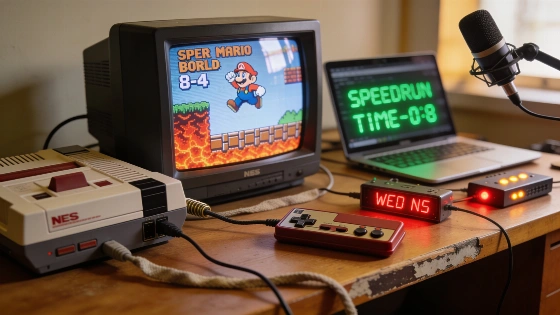
Niftski is not alone in this pursuit. LeKukie, another leading runner, has matched previous world records and is now also within striking distance of the perfect run. LeKukie's journey has been shaped by hardware limitations, including early practice on a homebrew emulator for PlayStation 2 with significant input lag and later on a Brazilian NES variant that ran slightly slower than standard models. Despite these obstacles, he consistently posted competitive times, and the community eventually rallied to provide him with a full-speed NES and streaming equipment-support that included contributions from Niftski himself.
This spirit of collaboration, even among direct competitors, has been a defining feature of the Super Mario Bros. speedrunning scene. Both runners are now pushing the boundaries of what is possible, with either potentially set to achieve the first human tie with the TAS time in the Any% category.
Technical context and remaining challenges
The technical barrier to a perfect run is now measured in frames rather than seconds. The NES version of Super Mario Bros. only checks for level completion at specific intervals, meaning there is a hard lower limit to how quickly each stage can be finished. While individual levels have been completed at TAS pace, stringing together every required trick in a single, uninterrupted run remains the final hurdle. The last stage, 8-4, is particularly notorious for its sequence of frame-perfect tricks, many of which must be executed back-to-back without hesitation.
With the difference between the current world record and the TAS time now just 0.06 seconds, the community widely regards a human-tied perfect run as inevitable. However, the precise timing and consistency required mean that even the smallest error can end a record attempt, and the margin for improvement is vanishingly small.
Why this milestone matters
The Super Mario Bros. Any% speedrun has long been a benchmark for technical excellence in retro gaming. Achieving a time indistinguishable from a TAS would represent the culmination of years of incremental progress, community knowledge-sharing, and individual dedication. It would also set a new standard for what is considered possible in speedrunning, not just for Super Mario Bros. but for classic games more broadly.
As the gap narrows to a handful of frames, the focus has shifted from broad strategy to the finest details of execution and hardware consistency. The next breakthrough-whether by Niftski, LeKukie, or another contender-will be the result of thousands of attempts, deep technical understanding, and a community that continues to refine every aspect of the run.
Understanding the concept of a tool-assisted speedrun (TAS) is essential to appreciating this achievement. A TAS is created by scripting perfect inputs on an emulator, allowing for theoretically flawless play that is often impossible for humans to replicate in real time. The fact that human runners are now within four frames of this standard highlights both the limitations of the original hardware and the extraordinary skill of today's top speedrunners. The remaining challenge is not just about reflexes, but about mastering the precise timing and consistency required to match a machine's perfection.