
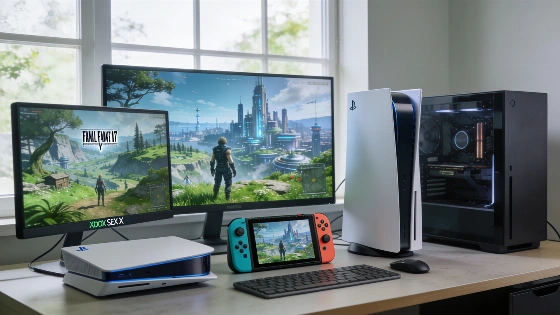
Square Enix has confirmed Final Fantasy VII Revelation as the intended conclusion to the remake series but has not ruled out further entries if player demand is strong while Final Fantasy XVII remains unannounced and shrouded in uncertainty
Square Enix has positioned Final Fantasy VII Revelation as the final chapter in its ambitious remake project, but the publisher is not closing the door on further entries if the appetite from players proves irresistible. According to GamesRadar, director Naoki Hamaguchi has stated that while the remake trilogy is intended to end with Revelation, he would not rule out future Final Fantasy VII spin-offs if fan reaction and demand justify them. With the series producer openly acknowledging the impact of fan enthusiasm on past spin-offs, the future of the Final Fantasy VII sub-series is now a question of demand rather than design.
Remake Series Reaches Its Planned Endpoint
Final Fantasy VII Revelation is being developed as the third and final part of the remake series, with a release scheduled for 8 April 2027 on PlayStation 5, Xbox Series X|S, Nintendo Switch 2, and PC, as reported by Polygon. Square Enix has invested heavily in this entry, promising an open-world structure, refined combat, and expanded character customisation. The publisher has highlighted the new combat design for Cid and Vincent, aiming to deliver a fresh experience even for long-time fans.
Despite this being billed as the conclusion, Square Enix's leadership has made it clear that the story could continue if the response is strong enough. Hamaguchi told AFP that he would be willing to hand the series to Square Enix if the publisher wanted to pursue further reinterpretations of the FFVII saga after the remake trilogy ends. The enduring popularity of characters like Cloud, Barret, Tifa, Aerith and Sephiroth has already led to multiple spin-offs and the current remake project. The company's willingness to revisit the world of Final Fantasy VII is not theoretical-past fan reaction directly resulted in titles such as Advent Children and Crisis Core.
Uncertainty Surrounds Next Mainline Entry
While the remake series is drawing to a close, the silence around Final Fantasy XVII is striking. Unlike the period when Final Fantasy VII Remake and Final Fantasy VII Rebirth launched alongside Final Fantasy XVI, there is currently no new mainline entry on the horizon. This absence is particularly notable given that Final Fantasy XVI did not meet sales expectations, raising questions about the franchise's direction and the publisher's willingness to commit to a new world or narrative structure.
Square Enix's current focus is squarely on delivering the highest possible quality for Final Fantasy VII Revelation. The publisher has not confirmed any plans for Final Fantasy XVII, nor has it provided hints about the next setting or gameplay direction. This leaves the franchise at a crossroads, with the possibility that the future could be shaped by the reception to Revelation rather than a pre-determined creative vision. According to a current Square Enix sale page, the remake line remains commercially active and is still being promoted, with Final Fantasy VII Remake Intergrade and Final Fantasy VII Rebirth among discounted titles through mid-to-late September 2026.
Player Demand and Creative Constraints
The publisher's openness to extending the Final Fantasy VII sub-series is rooted in the measurable impact of player demand. However, there is a risk that continued reliance on the same cast and setting could limit creative possibilities. The remake series has delivered strong gameplay, particularly in its combat systems, but every new feature must fit within the established boundaries of the original story and world. This constraint could stifle innovation compared to a new mainline entry set in an entirely fresh universe. Hamaguchi's comments to GamesRadar and AFP reinforce that any future projects would be contingent on fan enthusiasm and Square Enix's strategic direction.
Some players and commentators have expressed concern that prolonging the Final Fantasy VII narrative may dilute the impact of the original and restrict the franchise's ability to surprise. The hope among many is that Square Enix will continue to explore new worlds and mechanics, while occasionally revisiting older entries for special projects. The company's approach to traditional turn-based gameplay, as seen in titles like Final Fantasy Resonance, may also offer a path for satisfying different segments of the fanbase.
Technical Ambition and Platform Reach
Final Fantasy VII Revelation is set to launch across all major platforms, including PC, PlayStation 5, Xbox Series X|S and Nintendo Switch 2. According to independent reporting cited by MixVale, Square Enix has confirmed simultaneous launch plans for Final Fantasy VII Revelation across PS5, Xbox Series X|S, and PC, marking a break from earlier timed-exclusivity patterns. The game's open-world design and expanded combat systems represent a significant technical undertaking for Square Enix. Additionally, Eurogamer reports that while the trilogy's third game will receive a physical release, players will still need to download extra data because the full game does not fit on-disc for all platforms.
With the remake series concluding, the publisher's next move will be closely watched by players and industry observers alike. The decision to continue with more Final Fantasy VII content or pivot to a new mainline entry will likely depend on both commercial performance and the creative appetite within Square Enix's development teams. For now, the only certainty is that the franchise's future remains as unpredictable as ever.
Remakes and remasters occupy a unique space in gaming, offering the chance to revisit beloved stories with modern technology while also presenting creative limitations. Unlike a new mainline entry, a remake must balance nostalgia with innovation, often working within the constraints of established characters, worlds and plotlines. This can result in highly polished experiences that nevertheless feel less adventurous than wholly original titles. For players, understanding the difference between a remake and a new entry is crucial when setting expectations for gameplay, narrative scope and technical ambition.