
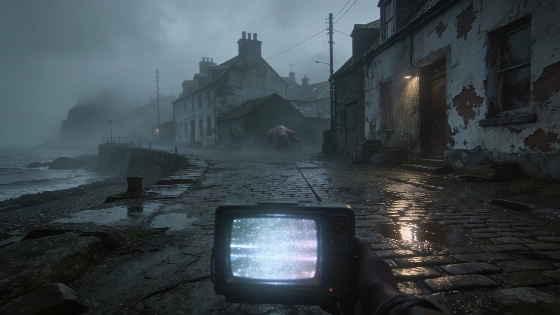
Silent Hill: Townfall brings atmospheric horror to PS5 and PC, with inventive level design and smart puzzles. Its familiar story and unreliable stealth keep cutting into the tension.
Silent Hill: Townfall can still make a street hidden by fog feel dangerous. Its most persistent threat, though, is not the monster in the dark. It is the feeling that the game has already shown you most of its ideas.
Townfall is a first-person survival-horror game from Screen Burn Interactive, the studio formerly known as No Code and associated with Stories Untold and Observation. It launched on PlayStation 5 and PC. Steam and Epic Games Store versions are available, and no Xbox edition has been announced. The PlayStation Blog says Konami presented it as a standalone Silent Hill story, not a direct continuation of an earlier entry.
A familiar nightmare
Townfall is set in 1996. Simon Ordell washes ashore in the seaside Scottish village of St. Amelia with no clear memory of who he is or how he got there. Fog swallows the town. Fleshy creatures move through it. Simon searches for Zoe, a woman who remains just beyond his reach.
The structure is recognisably Silent Hill: broken clues, cryptic survivors, monstrous manifestations and a protagonist forced to face buried guilt.
The Scottish coastal setting gives the game a different cultural and visual frame from the series' better-known American atmosphere. Its basic language remains familiar, though. Townfall does make one worthwhile shift. Its fears lean towards medical horror and corporate malfeasance instead of the psycho-sexual themes more closely tied to the series.
Simon is not the only playable character. Zoe and another figure each take over for a chapter. The changes in perspective add some welcome variety, but they never create the intimate psychological connection that gives the strongest entries their lasting power.
Townfall explains its characters without fully involving the player in their pain. The revelations work well enough, and the twists are arranged competently. The story still keeps the audience at a distance instead of making its guilt feel personally uncomfortable.
The timing and price put Townfall in a fairly compact premium release bracket. The standard edition is listed at $49.99. The Deluxe Edition costs $59.99 and includes 48-hour early access. The standard release date is September 24, 2026. Deluxe owners receive access from September 22.
Design finds its rhythm
The first-person view suits Silent Hill. Simon explores abandoned places, examines objects, solves environmental puzzles and carries a small set of weapons: a melee tool, a pistol, a shotgun and a flare gun.
Combat is possible, but it is rarely satisfying. Blocking an attack and answering with a couple of swings soon becomes repetitive. Firearms work well enough without feeling powerful, and ammunition is limited.
One of Townfall's better ideas is Simon's portable television. It looks like a small Game Boy. When a particular frequency matters, the device emits static and then shows a short video pointing towards the next objective.
The television also works as a crude enemy detector. It gives Simon a rough idea of where danger is waiting. Along with a map that slowly adds hints, it eventually makes the confusing town easier to read.
That help comes later than it should. The opening hour to 90 minutes drops Simon into St. Amelia with little direction. Doors mostly lead nowhere, and side routes often end without purpose.
Progression often depends on finishing an apparently unrelated task before a path that seemed useless becomes available. This old-school adventure-game logic can feel satisfying once its rules become clear. The introduction, though, treats confusion as if it were mystery.
After that weak opening, the level design becomes the game's clearest strength. St. Amelia eventually gives way to more focused survival-horror stages. Each chapter tries something different.
Zoe's medical procedures provide an especially unusual change of pace. A more action-led shotgun sequence briefly lets the player push back against the nightmare. This variety gives Townfall a stronger middle act than its first impression suggests.
Stealth breaks the spell
Townfall struggles to hold its tension when stealth becomes the main activity. Simon can crouch, move around corners, hide in cupboards and use the television's rough radar. The system itself stays very narrow.
Early enemies are dim-witted enough for those tools to work. Later encounters show how little room the game leaves for improvisation.
An invulnerable stalker can kill Simon in one hit. Its behaviour is too erratic to create a satisfying cat-and-mouse contest. It may trap the player in a room without offering a clear way out. What should be a test of nerve becomes a series of trial-and-error deaths.
The comparison with Alien: Isolation is hard to avoid. Townfall combines a handheld detection device with plenty of hiding places, but it never matches that game's controlled pressure.
The stealth becomes tiring instead of frightening. Repeatedly slipping past the same enemies would be manageable if the stalker followed readable patterns. Its capricious movement makes failure feel disconnected from the player's decisions. That weakens the central horror loop when the game most needs it to tighten.
This is also where Townfall differs from other gaming coverage. A release report such as an earlier expansion report deals with promised content and future value. This review concerns what is actually delivered in play. Townfall's stealth is the clearest example of that difference.
Atmosphere without staying power
Townfall's presentation is uneven. Its character models and environments are moderately detailed rather than technically striking. Performance can also sputter on PS5.
Some heavily stylised sequences leave a stronger impression than the everyday spaces. The soundtrack rarely fills the gap. Akira Yamaoka's absence is noticeable because the audio lacks the distinctive weight and unease associated with the series.
The puzzles fare better. Townfall rarely explains exactly what it wants from the player, but most challenges have a twisted internal logic that rewards observation and experimentation.
A few puzzles irritate more than they intrigue. Most provide the kind of resistance survival horror needs. The campaign lasts at least a dozen hours and can run longer when a sequence causes trouble. The multiple endings offer limited reason to return.
Those endings are mainly tied to figures such as kills and documents discovered, rather than meaningful moral decisions or branching routes. That gives dedicated players a reason to inspect every corner. It does not create enough variation to make repeated visits to St. Amelia feel essential.
The package has atmosphere, puzzles and several memorable set pieces. It never builds towards a transformative final impression.
Konami and the official Silent Hill account have confirmed that a patch is being prepared for the Steam and Epic Games Store versions. The release date for that update has not yet been announced. It therefore does not change the assessment of the launch build discussed here.
First-person horror works best when limited information makes every movement feel deliberate. Townfall understands the value of restricted visibility and a close perspective. Its stealth systems do not consistently support that design.
The result is a solid traditional Silent Hill experience with inventive spaces and genuine flashes of dread. Its familiar narrative, forgettable soundtrack and frustrating stalker keep it below the series' recent high standards.
Townfall is worth considering for players who want another substantial survival-horror campaign. Those looking for a defining nightmare should look elsewhere.