
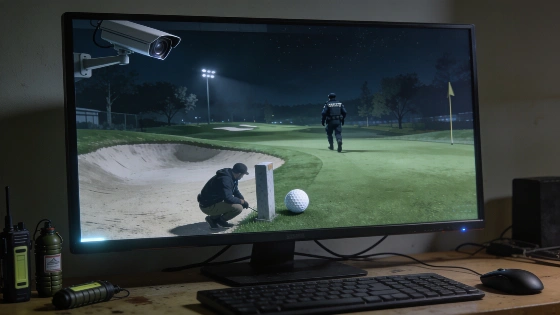
No More Robots and New Zealand studio Pushlab Games have revealed Really Illegal Golf, a multiplayer stealth game about disgraced golfers sneaking onto guarded courses and turning every round into nighttime chaos.
Really Illegal Golf starts with a revoked golf-club membership. It ends with armed trespassers trying to finish a round while security patrols and CCTV track their movements. No More Robots and New Zealand studio Pushlab Games announced the game on September 20, 2026. It is a multiplayer stealth game with a free Steam demo available now. The full release is planned for 2027.
A golf course after dark
The premise is far more chaotic than normal competitive golf. Players control a group of rowdy golfers who have been barred from their local club. Their answer is to break in at night. The goal is not simply to reach the hole. Players must survive the course while making terrible decisions with a golf ball in hand.
That gives the sports format a tactical layer. Security patrols and CCTV turn the fairways into spaces that must be crossed with care. Obstacles can also become tools. If something blocks the route, players can hit the ball into it instead of treating it as a fixed barrier.
PC Gamer describes the project as a multiplayer stealth game rather than a standard sports simulation. The central task is to move across the course while avoiding its guards. The announcement focuses on mischief instead of realistic golf. The course is both the sporting arena and the stealth map. A successful round depends on movement and detection as much as it does on judging a shot.
Gematsu also presents the premise as a comic response to losing club membership. The players return for an unauthorised game of golf. That context explains the game's exaggerated stealth-action tone and sets Really Illegal Golf apart from a traditional golf simulator.
Stealth with friends
Really Illegal Golf supports solo play and multiplayer sessions. Friends can compete against one another or work together against the guards. The source material does not specify the player count or the exact structure of its competitive modes. Those details remain open.
Co-operative play is the stronger hook. One player can create a distraction while another lines up a shot or handles an obstacle. A bad throw can ruin the plan. Noise and confusion may expose the whole group to the course's security systems.
Customisation goes beyond appearance. Players can choose gear from an arsenal that includes tasers and grenades. The announcement does not explain how those items are earned or balanced. It is too early to know whether the equipment will create real tactical choices or simply add more spectacle.
From club grounds to military land
The courses are meant to become harder as the game progresses. The announcement points to military land as a later setting. The consequences of using restricted territory as a golf course are more serious there. The developers have not provided a course count, mission total, or detailed progression system.
That escalation gives the reveal a clear shape, but it does not show how deep the final campaign will be. The basic idea is easy to understand. Players avoid detection while using the ball and the surrounding environment to keep moving. The military setting suggests more hazards. The available information does not confirm additional enemy types or advanced security systems beyond the patrols and CCTV already described.
The game was shown publicly during PC Gaming Show Tokyo Direct 2026. That gives the reveal a prominent event setting instead of making it only a publisher press announcement. The trailer shows the central premise, not the game's technical performance. No platform performance targets, resolution figures, or final interface details have been provided. The trailer can establish the tone and mechanics being presented, but it cannot confirm how the finished release will run.
Demo and launch plans
A free demo is available on Steam now. It gives players a direct way to test the idea before launch. That is more useful than a feature list because stealth multiplayer depends on how detection and shared improvisation feel in practice. The demo is not the finished game, and its content and limitations have not been detailed.
The confirmed timetable is short. Really Illegal Golf was announced on September 20, 2026, alongside the Steam demo. The game is scheduled to launch in 2027. Gematsu reports only that release window. No specific day or month has been announced. The available announcement material lists no confirmed platform beyond the PC/Steam project and its current demo.
There is also no authoritative confirmation that the full game has already been released or that it has received later official patches or a changed status after the announcement. The available information describes a revealed project with a playable demo, not a completed launch.
The announcement fits a wider pattern of small multiplayer projects using Steam demos to put unusual ideas in front of players early. An earlier Steam demo for Star Conflict Burrownauts took a different route with mining and bullet-heaven combat. It still made the storefront part of the game's reveal.
Stealth multiplayer works best when detection creates pressure without taking away player control. In Really Illegal Golf, the ball is more than a way to score. It can interact with the course and create trouble. That gives Pushlab Games a sharper idea than a standard party sports game. The free demo can show whether the joke holds up over repeated play.
Based on the information available now, this is a focused announcement rather than proof of a complete multiplayer package. The 2027 launch will need enough course variety and tactical depth to support the premise.
The key test is the gap between a planned route and a system that reacts when players break it. CCTV and patrols can create that pressure if their detection rules are clear and consistent. The Steam demo should be judged less by the number of hazards it lists than by whether players can understand why they were spotted and change their next shot.