
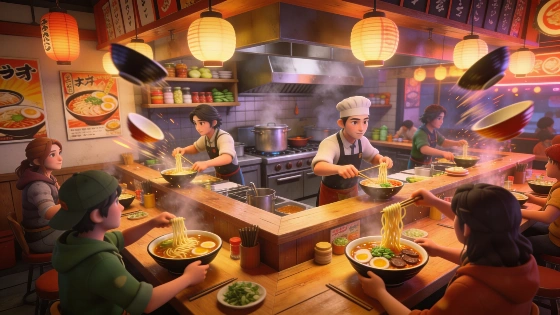
Wild Dog will launch Japanese Ramen Simulator on Steam Early Access on 9 October, with room for up to 10 players and a 15% launch discount.
Japanese Ramen Simulator opens on Steam Early Access on 9 October 2026. Players will prepare ingredients, cook noodles, serve customers, clean the shop and keep the business running as they build their own ramen restaurant.
Steam launch details
Tokyo-based indie studio Wild Dog will release the game at 08:00 UTC on 9 October 2026. That is 01:00 PDT, 04:00 EDT, 09:00 BST and 17:00 JST. A 15% launch discount is planned for the opening period. The game will be available for Windows 10 and 11 through Steam.
Wild Dog confirmed the date on 6 October. The studio had first planned to release the game on 28 September, but the Steam review was not finished in time. Game*Spark reported that Wild Dog said on 2 October it had fixed Valve's feedback on controller support settings and cloud synchronisation before sending the build back for review. Famitsu later reported the final schedule, including the 17:00 JST launch time.
The delay came during a period of closed beta testing. Wild Dog started its fourth closed beta on 3 October for up to 1,000 participants. Testing was due to continue until release. The game had 100,000 Steam wishlists by 24 September and more than 200,000 by 6 October, according to Game*Spark and Famitsu. Wishlists show interest, not sales or long-term player retention. Still, they give the Early Access launch a large audience on day one.
The recommended price is 1,900 yen including tax. The 15% launch discount cuts that to 1,615 yen. Game*Spark reports that Wild Dog called the lower opening price compensation for the postponed release. Early Access is expected to last roughly six months. The price may rise in stages as major updates arrive and the full release gets closer.
Japanese Ramen Simulator supports one to 10 players online, though Wild Dog recommends groups of up to six. Players can also run the shop alone with part-time NPC staff. That offers a slower way to work through the same shop-building systems.
Players should check their hardware before entering the kitchen. The PC version lists a minimum requirement of at least 6 GB of VRAM. Gaming-St reported that the developer specifically told beta participants to check this requirement.
Cooking has real consequences
The main task is more than dropping ingredients into a bowl. Players can adjust the broth, noodle firmness, soup temperature, aroma and Umami. They can then arrange toppings through physics-based interactions. The game also tracks serving times and customer orders. A well-made bowl can still hurt the business if the kitchen cannot keep up.
That gives the Early Access build a different feel from a shop simulator focused mainly on decoration. The kitchen is a production line and a place to experiment. Players can recreate familiar ramen or try combinations that move beyond a traditional menu. The food also includes gyoza, rice bowls and beer. One option is char siu over rice. Beer must be poured with the right balance of liquid and foam.
Wild Dog is adding problems that force players to react. A demanding ramen critic may arrive. Thieves can target the cash register. Fires can break out during business hours. Fire extinguishers and shuriken are available when trouble starts. A gambling hall adds a separate risk-and-reward activity.
A shop built for groups
Co-operation depends on splitting up the work. One player can prepare ingredients while another cooks. Someone else can serve customers, and other players can clean or handle customer service. Spatial voice chat changes with distance and walls. That should make a busy kitchen easier to follow than a standard party-chat setup, provided the team keeps its jobs organised.
The building tools cover more than most ramen management games. Players can place cooking equipment, storage, furniture and decorations in the kitchen and dining area. Earnings unlock ingredients and equipment as the Shop Level rises. Players can change clothing, body shape, emotes and noodle-draining animations. Custom designs can be added to posters, noren curtains, ramen bowls and clothing.
These systems are not only about efficiency. A player can build a compact restaurant for fast service or create a more distinctive space for friends to visit and photograph. The game also includes interactive fixtures such as toilets and gas cylinders. Wild Dog appears to want the shop to feel like a real place rather than a menu screen with counters.
The game joins a wider wave of co-operative management titles that turn routine work into social play. Readers looking for another physics-led indie experiment can compare it with an earlier sandbox release. Japanese Ramen Simulator puts those systems in a staffed restaurant instead of a destruction playground.
Early Access is the real test
The launch build includes ramen and gyoza cooking, beer service, customer care and shop arrangement. Wild Dog plans to improve the systems and add content during Early Access. The studio will collect player feedback through the Steam Community Hub and its official Discord. The 9 October version is the restaurant's starting point, not its finished form.
The studio has also included camera options that may matter for comfort. Players can switch between first-person and third-person views. The third-person option shows the character and the surrounding shop. That choice may help people who feel motion sick in first-person games. The supplied announcement does not give a detailed accessibility feature list beyond those camera options.
Wild Dog says its small Japanese team visited ramen shops, made ramen repeatedly, recorded cooking sounds and scanned some real-world materials. Those steps may add tactile detail, but they are development claims rather than independent proof of final quality. No review access, performance testing or launch stability results have been supplied. The practical questions are how the physics behave under pressure and how reliably a ten-player shop handles a full service.
Early Access does not guarantee that every planned system will arrive unchanged or that the first build has its final balance. It is a paid development stage. The playable foundation is available while the studio keeps adding content and adjusting mechanics. Japanese Ramen Simulator has enough structure to interest groups that enjoy assigning jobs and building their own spaces. Its 200,000 wishlists cannot answer the bigger question: will the kitchen stay fun after the novelty fades?