
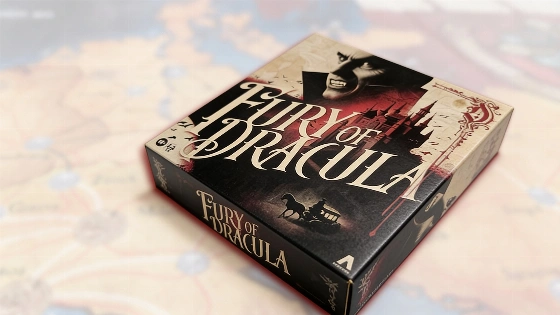
Avalon Hill has released Fury of Dracula 5th Edition, reviving the sought-after hidden movement board game with new gameplay options and a controversial visual overhaul. Here's what's changed, what remains familiar, and what players should expect
Dracula's hunters are back on the trail, but this time the chase is complicated by a controversial new look and a handful of gameplay tweaks that risk unsettling the balance of a cult classic. Fury of Dracula 5th Edition has landed, ending years of scarcity and debate over which version best captures the tension of the original. The return of this one-versus-many hidden movement game is not just a reprint-it's a statement about what modern board game editions owe to their legacy and their players.
What's Actually New
The 5th Edition, published by Avalon Hill, preserves the core mechanics that made Fury of Dracula a favourite among hidden movement enthusiasts. One player controls Dracula, moving secretly across the map and sowing chaos, while up to four others play as hunters determined to corner and defeat him. The structure remains: day and night phases, secret trails, and the ever-present threat of the despair track ticking towards Dracula's victory.
However, this edition introduces two notable changes. First, Jonathan Harker is now a playable hunter, no longer relegated to an ally card. Harker brings unique abilities-extra damage against Dracula and a tracking skill that can force Dracula to reveal his proximity. Yet, his integration feels incomplete. Harker lacks a dedicated event card and instead borrows from the hunter he replaces, raising questions about balance, especially when both Harkers are in play. Second, a new fast-play variant shortens the game by blocking off parts of the map and starting with an advanced board state. This mode is designed to cut playtime from the notorious four-hour marathons to something more manageable for a weeknight, but it also shifts the difficulty, making Dracula's escape more challenging and the game's swinginess more pronounced.
Gameplay and Tension
Fury of Dracula's defining feature remains its hidden movement system, which creates a cat-and-mouse dynamic unlike most board games. Dracula's movements are tracked with face-down cards, leaving traps and encounters for hunters to discover. The tension escalates as the hunters close in, with every move potentially revealing Dracula's location or triggering a dangerous encounter.
Combat, a distinguishing element compared to other hidden movement games like Whitehall Mystery, is resolved through simultaneous card selection. Hunters and Dracula choose actions or items, then reveal and resolve effects. The system is simple but effective, producing moments of genuine suspense-misreading an opponent can mean the difference between victory and a sudden, game-ending defeat. The despair track, which advances when Dracula's schemes mature or hunters are incapacitated, ensures that every decision carries weight.
Visual Overhaul and Player Reaction
The most divisive change in the 5th Edition is its visual identity. While the map now includes Whitby, a location central to Bram Stoker's novel, the artwork for cards and character portraits has shifted from the dramatic, full-colour illustrations of previous editions to black-and-white drawings reminiscent of Victorian newspapers. Event, encounter, item, and combat cards all adopt this style, which some players find atmospheric but others dismiss as lacking impact or even appearing corny. Notably, the "Dark Call" and "Misdirect" cards have lost much of their previous menace, and the sepia-tinted character photographs raise questions about thematic consistency-can Dracula even be photographed?
For returning players, this aesthetic shift is more than cosmetic. It alters the mood of the game and may affect immersion, especially for those who valued the gothic drama of earlier editions. The change is not universally welcomed, and it stands as a reminder that visual design is not a trivial afterthought in board game publishing.
Balance, Legacy and the State of the Game
Despite the new features, the 5th Edition's core remains largely unchanged from the 3rd and 4th editions. The addition of Jonathan Harker and the fast-play mode offer variety, but both feel under-tested, with balance concerns that could frustrate experienced players. The game's length, even with the new variant, can still stretch beyond two hours, and the new artwork risks alienating long-time fans who preferred the previous style.
For those who missed out during the game's out-of-print years, the 5th Edition is a welcome return. It restores access to a classic, even if not every change will please the purists. The decision to overhaul the art and introduce new mechanics without fully integrating them suggests a publisher caught between modernising and preserving what made the game special. As with the recent reported earlier on franchise costume redesigns, the tension between innovation and tradition is not easily resolved. The 5th Edition is playable, tense, and still capable of producing unforgettable moments, but it is not the definitive version for every player.
Hidden movement games rely on secrecy, deduction, and the psychological battle between players. In Fury of Dracula, the despair track is a central mechanic that measures Dracula's progress towards victory. Each time Dracula's schemes mature or a hunter is defeated, the track advances, putting pressure on the hunters to act decisively. This system ensures that the game cannot drag on indefinitely and that every encounter has real consequences, maintaining the pace and tension that define the genre.