
Big Walk, developed by House House, challenges players to solve open-world puzzles through proximity voice chat and teamwork, offering a distinctive co-op experience that relies on shared language and creative problem-solving
Big Walk is a co-op-only puzzle adventure from House House that places communication at the heart of its design. Rather than providing explicit objectives, the game drops players into a vibrant, open world where progress depends on teamwork, observation and the gradual development of a shared vocabulary. The result is a multiplayer experience that feels both experimental and refreshingly personal, as groups must invent their own terms and strategies to overcome the game's challenges.
Communication as Core Gameplay
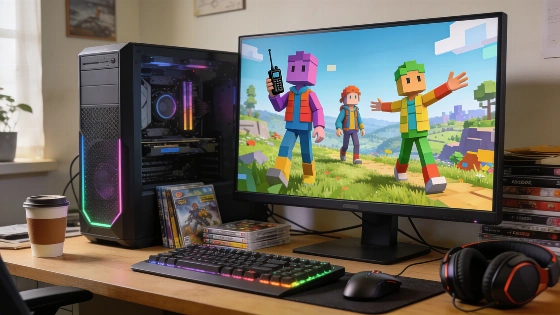
Unlike most multiplayer titles, Big Walk restricts communication to proximity-based voice chat, meaning players can only hear each other when nearby. This design choice shapes every aspect of play, from puzzle-solving to navigation. The absence of clear instructions or objectives encourages players to experiment, test the environment, and develop their own language for objects and locations. For example, players might refer to red, peanut-shaped items as "beans" and designate certain structures as "bean towers", with these improvised terms becoming essential for coordination.
Big Walk supports groups of up to 12, with puzzles dynamically adjusting to the number of participants. The game's world is filled with interactive elements-buttons, switches, and environmental features-that require close cooperation. Tasks range from simple fetch quests to more complex challenges involving synchronised actions or relaying information across distances. The proximity chat system means that splitting up can lead to genuine separation, forcing players to devise creative solutions to regroup or communicate, such as using flares or body language.
Puzzle Design and Progression
Puzzles in Big Walk are scattered across a large, open map and are often embedded within colourful, distinctive structures. Some require physical coordination, like guiding a blindfolded teammate through an obstacle course, while others test memory, timing, or the ability to relay information under communication constraints. The game avoids a linear difficulty curve, allowing players to tackle puzzles in any order and at their own pace.
Each completed puzzle typically rewards the group with a red bean, which must be transported back to a bean tower. Collecting enough beans unlocks new tools or access to previously unreachable areas, such as a train or a chair lift. The save system is tied to the original host, meaning progress is only retained when that player is present. This can be limiting for groups who wish to continue without the host, but it reinforces the importance of shared experience and group continuity.
Technical and Social Dynamics
Big Walk's world features a day-night cycle, with darkness introducing new challenges for navigation and communication. Losing essential tools like flashlights or walkie-talkies can make regrouping difficult, but these setbacks often lead to memorable moments rather than frustration. The game's movement system, which relies on arm gestures and simple controls, can occasionally be imprecise, but rarely disrupts the overall flow.
Sessions are designed to be flexible, allowing players to drop in and out, though the host-based save system means that only the original group's progress is preserved. Over the course of extended play-some groups report spending nearly 20 hours exploring-players naturally develop a unique set of signals and strategies, making each group's experience distinct. This emergent communication is central to the game's appeal, echoing the way language and relationships form in unfamiliar environments.
Why Big Walk Stands Out
What sets Big Walk apart is its commitment to making communication itself the puzzle. The reliance on proximity chat and the absence of explicit guidance create a sense of discovery that is rare in modern co-op games. The game's design encourages players to invent their own systems, fostering a sense of ownership over the world and its challenges. This approach is reminiscent of other titles that prioritise player-driven exploration and interpretation, such as those highlighted in our coverage of retro-inspired puzzle adventures.
Big Walk's puzzles are consistently inventive, rewarding not just technical skill but also creativity and collaboration. The game's world is designed to nudge players towards building something together-whether that's a shared language, a coordinated plan, or simply a memorable story. While the lack of solo play and the host-dependent save system may not suit every group, the experience is tailored for those who value cooperation and emergent play over traditional progression systems.
Understanding proximity-based voice chat is key to appreciating Big Walk's design. Unlike global or party chat, proximity chat limits communication to those within a certain in-game distance, simulating real-world conversation and introducing natural barriers to coordination. This system can heighten immersion and tension, as players must physically regroup to share information or solve puzzles. It also encourages creative problem-solving, as groups develop non-verbal cues and alternative methods to communicate when separated. For players seeking a co-op experience that genuinely tests teamwork and adaptability, Big Walk offers a distinctive and memorable approach.