
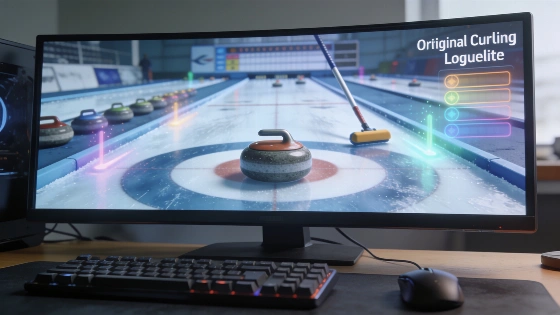
BurGum Games has released a Steam demo for Rogue Curling, a curling roguelite where throw precision works alongside build crafting and rule-breaking combinations ahead of its planned PC release.
Rogue Curling is now playable on Steam, and its central gamble is clear: a strong build cannot rescue a poor throw. BurGum Games released the early version of its curling roguelite ahead of a planned PC launch during 2026-2027. SteamDB lists the public demo separately as Rogue Curling Demo. Its App ID is 5248640, and the database records September 9, 2026 as the latest data change confirming the demo's presence on Steam.
A demo with real stakes
Rogue Curling takes the deck-building logic associated with Balatro and puts it into a sport where power and direction still decide the outcome. Players must build a scoring kit while controlling where each stone goes. Long-term planning and immediate execution are tied together.
That also separates Rogue Curling from the physics-driven score attack covered in an earlier report. Here, the physics are not just the spectacle. They are part of the scoring problem the player has to solve.
The demo is available through Steam, giving players a chance to try the announced concept before the full release. SteamDB's listing records a Last Changenumber of 38733489. The application page was updated in the system on September 22, 2026. That activity suggests the project is still receiving technical changes after its initial announcement, although the public data does not say what those changes contain.
The demo arrives during a busy period for smaller Steam releases. GameGrin's roundup of demos launching during September 21-27, 2026 includes new demo activity on the platform. Early playable versions remain one way for indie projects to reach players. BurGum Games has not provided a fixed launch date, price or final content list in the supplied announcement. SteamDB does not list those final-release details either.
Build around the stones
Rogue Curling's progression systems focus on changing the equipment rather than simply improving a character. Players can buy stones to improve scoring efficiency. They can then change the size and material of stones they own, altering their advantages.
Brooms add another layer. The studio describes them as combination pieces that can interact with stones. Amplifiers improve stone abilities and statistics. The aim is to make individual items more useful when they form a compatible setup instead of being used alone.
The announcement also embraces deliberately excessive combinations. Players can find synergies described as game-breaking and exploit them. Breaking the rules is part of the game's identity, not an accidental loophole.
Skill beyond the build
The main claim is not the number of upgrades. It is the link between those upgrades and execution. BurGum Games says the force and direction of every throw will still matter, even after a player has assembled an ideal build.
That gives the demo a practical question to answer. Does its equipment system deepen the decisions in curling, or does it simply add bonuses around a familiar physics challenge? The available announcement sets out the intended structure. It does not provide independent testing, measured scoring balance or evidence from the finished game.
For players, the distinction matters. Rogue Curling is not presented as an automated build simulator where the right purchases decide every result. The throw itself is meant to remain an active skill check. Whether that balance feels precise or frustrating can only be judged through the playable demo and later development builds.
A small team with a large ambition
BurGum Games is a two-person indie studio based in Portugal. Artem is identified as the game designer and has 10 years of gamedev experience. Valeria is an illustrator with 6 years of experience and a portfolio containing 4 released games. The team says its move toward independent development followed Artem's discovery of the open-source Godot game engine.
The studio's previous games are Tidy Backpack, Birdfull and Alien Morgue. Rogue Curling is another small-scale project from a team working across design and illustration. It is not a production backed by a large publisher.
The timetable remains broad. The full PC version is planned for Steam in 2026-2027, while the demo is already available. No console version, multiplayer mode, pricing structure or final release date has been announced in the supplied material. SteamDB's public metadata also contains no fixed final-release date, price or complete content list. There is no independent confirmation of an exact PC launch date in the indexed sources. For now, the demo is the concrete milestone players can access.
Physics-based curling works when the two sides of the design push against each other. Equipment choices shape what is possible, while the throw decides whether those possibilities become real. A synergy can improve the numbers, but it cannot remove the need to aim and control power. That makes Rogue Curling a convincing premise, not a proven finished package. The Steam demo is the clearest test of whether its tactical systems genuinely reward precision.