
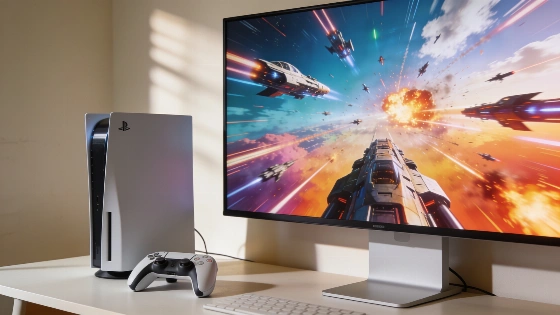
Wild Blue Skies attempts to revive the classic rail shooter formula but leans heavily on Star Fox 64, resulting in a game that rarely finds its own identity and often suffers from weaker controls, design and difficulty balance
Wild Blue Skies enters the rail shooter genre with clear ambitions to recapture the spirit of Star Fox 64, but its close imitation of Nintendo's classic leaves it struggling to establish a distinct identity. While the game offers moments of originality, these are often overshadowed by direct references and near-copies of Star Fox 64's structure, characters and level design. The result is a title that feels more like a tribute than a confident new entry, with gameplay and narrative choices that rarely surpass its inspiration.
Gameplay and Structure
At its core, Wild Blue Skies is a rail shooter that closely mirrors the format of Star Fox 64. Players pilot a ship through a branching sequence of six levels, selected from a pool of thirteen, with the aim of achieving high scores and collecting power-ups. The game features familiar mechanics such as bombs, blaster upgrades, charge shots and score multipliers. Certain stages introduce All Range Mode segments, granting full control over the aircraft within an arena, and the world map offers three difficulty paths-easy, medium and hard-depending on player choices and performance.
Despite this familiar structure, the game's controls and combat lack the precision and responsiveness that defined its predecessor. The main ship, the Cloudcutter, is notably less agile than Star Fox's Arwing, making manoeuvres feel sluggish. Bombs lack the satisfying impact and accuracy of their Star Fox equivalents, and blaster upgrades are inconsistently lost when taking damage, with no clear threshold or warning. These changes, while seemingly minor, combine to create a less rewarding gameplay loop, especially when compared to the tight design of the genre's best examples.
Difficulty and Progression
Wild Blue Skies adopts a harsher approach to difficulty and progression. Health pickups are scarce, checkpoints do not restore health, and there is no way to expand the player's health bar beyond its starting value. Extra lives are only available as in-level pickups, and blaster upgrades are both rare and easily lost. This design means that a single mistake can jeopardise an entire run, and the lack of recovery options often forces players to restart levels or accept significant setbacks.
While the game rewards skilled play with commendations-split into medals for collecting hidden letters and ribbons for high scores-these systems quickly become reliant on memorisation rather than improvisation. Once players know the locations of collectibles and optimal routes, replay value diminishes, and the punitive upgrade system can lock players out of certain achievements entirely. The game's challenge is less about moment-to-moment skill and more about learning and repeating specific patterns.
Level Design and Originality
One of the most significant criticisms of Wild Blue Skies is its heavy reliance on Star Fox 64's level templates. Many stages are near-direct recreations of classic Star Fox levels, with only superficial changes to setting or objectives. For example, Mines closely resembles Fortuna, Iceberg echoes Zoness, and Temple is a clear nod to Katina. Even boss encounters and mission structures are often lifted wholesale, with only minor adjustments to context or enemy types.
However, the game does occasionally demonstrate flashes of creativity. Levels such as Canyons and Cloudtop introduce unique sequences and boss fights that are not direct copies of Star Fox content. These moments, featuring inventive camera angles or original enemy designs, stand out as the game's highlights and suggest that the developers are capable of more than imitation. Unfortunately, these sections are the exception rather than the rule, and the overall experience remains dominated by familiar territory.
Narrative and Characterisation
The narrative and cast of Wild Blue Skies also draw heavily from Star Fox 64, with characters mapping almost one-to-one onto the original's roster. The protagonist, Bowie Stray, is a canine leader reminiscent of Fox McCloud, while supporting characters fill roles analogous to Peppy, Slippy and Falco. The antagonist, Grimclaw, and the overarching plot closely mirror the structure and stakes of Star Fox's campaign. While some new characters, such as Roe Whitetail, offer fresh performances and personality, the story rarely moves beyond homage, and emotional stakes are diminished by the lack of original context or development.
Wild Blue Skies' campaign can be completed in approximately six to seven hours, depending on difficulty path and player skill. The game's replayability is hampered by its reliance on memorisation and the absence of meaningful branching outcomes or secret content. While multiple routes exist, they often lead to similar conclusions, and the sense of discovery present in Star Fox 64 is largely absent.
To understand the limitations of Wild Blue Skies, it is useful to consider the concept of a remaster versus a remake. A remaster typically updates visuals and performance while preserving the original game's structure, whereas a remake reimagines core systems, design and narrative. Wild Blue Skies sits uncomfortably between these categories, borrowing heavily from its inspiration without fully reworking its ideas. The result is a game that feels familiar but rarely essential, highlighting the challenge of recapturing the magic of a classic without simply repeating its steps.