
Crystal Dynamics has showcased Tomb Raider Legacy of Atlantis with striking visuals and controversial gameplay changes including skill trees and survival elements raising questions about the direction of this ambitious remake
Crystal Dynamics has pulled back the curtain on Tomb Raider: Legacy of Atlantis, revealing a visually stunning reimagining of Lara Croft's original adventure that is already sparking debate among long-time fans. The latest preview, focused on the infamous Damocles Room, demonstrates a leap in graphical fidelity and scale, but also exposes a series of design choices that risk alienating the franchise's core audience.
Gameplay Changes and Player Concerns
The most immediate shift is the transformation of classic hazards into traversal aids. In the Damocles Room, once a deadly gauntlet of falling swords, the blades now serve as platforms for Lara to navigate the vertical space. The threat is diminished: swords can be safely triggered from a distance, and their danger is largely cosmetic. This approach, while inventive, has already prompted questions about whether the challenge and tension that defined the original Tomb Raider are being sacrificed for accessibility.
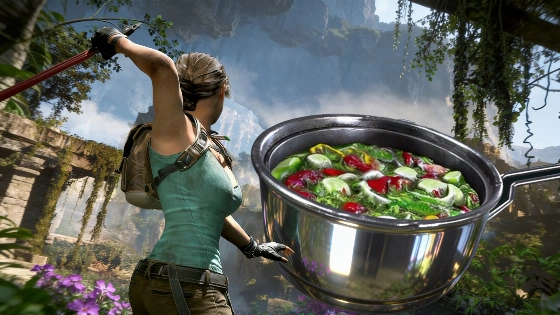
Legacy of Atlantis also introduces survival mechanics and skill trees, features that were absent from the 1996 original but became standard in the more recent Survivor Trilogy. Players will find themselves crafting meals from foraged ingredients and unlocking abilities as they progress, even though Lara is depicted as an experienced explorer rather than a stranded survivor. The inclusion of a detective mode scanner, offering optional puzzle hints and historical commentary, further signals a shift towards modern hand-holding, a move that some see as undermining the series' traditional emphasis on player discovery and problem-solving.
Visual Fidelity and Technical Ambition
On a technical level, Legacy of Atlantis is a showcase for Crystal Dynamics' current engine capabilities. The environments are rendered with a level of detail that far surpasses any previous Tomb Raider release, with atmospheric lighting, intricate textures, and a sense of scale that was impossible on earlier hardware. Lara herself is depicted with a blend of stylised and realistic features, merging the iconic look of the Legend trilogy with the grounded, survivalist tone of the 2013 reboot.
During the demonstration, the Damocles Room's towering pillars and shafts of light create a sense of awe, but the spectacle is not matched by equivalent gameplay risk. The leopard encounter, for example, is presented with cinematic flair but resolves in a scripted fashion, highlighting a tonal mismatch between the game's serious narrative ambitions and its sometimes incongruous action beats. The result is a game that looks and sounds like Tomb Raider, but often feels like it is borrowing mechanics from elsewhere without fully integrating them into the series' identity.
AI Controversy and Suspicious Details
Crystal Dynamics has confirmed the use of generative AI for early prototyping during development, though the studio insists that all final content will be human-made or human-refined. This admission has led to scrutiny of certain assets, particularly the food depicted in crafting menus, which appears visually unappetising and generic compared to the lavish meals seen in other major releases. While there is no direct evidence that these assets are AI-generated, the suspicion alone has cast a shadow over the project, especially among players wary of AI's role in creative industries.
The studio's decision to blend elements from multiple Tomb Raider eras-serving as both a replacement for the original and Anniversary versions and a sequel to the Survivor Trilogy-has resulted in a hybrid that struggles to reconcile its influences. The attempt to unify timelines and mechanics may appeal to some, but it risks diluting what made each era distinct. As seen in other genre-blending projects such as those reported earlier, the challenge lies in creating a cohesive experience rather than a patchwork of features.
Release Timing and Remaining Questions
Tomb Raider: Legacy of Atlantis remains in active development, with no confirmed release date or finalised platform list at the time of writing. The build shown is described as non-final, and Crystal Dynamics has stated that there is still time to refine mechanics and polish assets before launch. The studio's public stance is that player feedback will inform further changes, but it is unclear how much of the current design philosophy is open to revision.
For players, the most pressing questions concern the balance between nostalgia and innovation. Will the final game restore the sense of danger and discovery that defined the original, or will it continue down a path of streamlined progression and optional guidance? The answers will determine whether Legacy of Atlantis stands as a worthy successor or a well-intentioned misfire.
Remakes and reboots occupy a unique space in gaming, often tasked with satisfying both veteran fans and new audiences. A remake is not simply a technical upgrade; it is a reinterpretation that must justify its existence by offering something meaningfully different or improved. When a project leans too heavily on modern conventions-such as skill trees, survival mechanics, or AI-assisted asset creation-it risks losing the clarity of vision that made the original memorable. The best remakes understand what to preserve and what to reinvent, and the fate of Tomb Raider: Legacy of Atlantis will hinge on whether Crystal Dynamics can strike that balance before release.
Remakes differ from remasters in that they involve rebuilding a game's core systems, visuals, and sometimes narrative, rather than simply enhancing resolution or performance. This process allows developers to address outdated mechanics and introduce new features, but it also opens the door to controversial changes that may not align with player expectations. The challenge is to modernise without erasing the qualities that gave the original its identity-a task that remains at the heart of the current Tomb Raider project.