
Targem Games has announced The Drawratos, a cooperative poker game for 1 to 4 players. Players draw on cards, risk cheese and use tricks to take the pot, with a Steam playtest serving as the project's testing route.
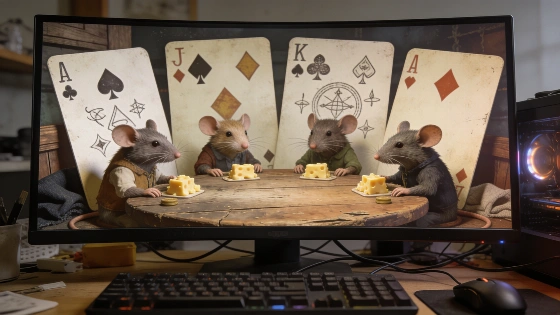
The Drawratos takes cheating at cards literally. Players can draw directly on their hands and change a card's suit or rank during the game.
Targem Games describes the project as a cooperative poker game for 1 to 4 players. Cheese replaces normal stakes, and a family of rats gathers around the table. The earliest confirmed public announcement found in the available results is dated 29 September 2026. GamesPress described the same 1 to 4-player format, card-drawing mechanic and cheese wagers.
Cards become the con
The main mechanic goes beyond bluffing across a table. Players can change their cards as a hand unfolds. They might alter the suit or rank to build a stronger combination, or to make another player read the situation incorrectly.
That creates two kinds of uncertainty in every round. Opponents must judge the cards they can see. They must also decide whether those cards have been changed.
The announcement does not explain the exact limits of the drawing system. It does not say how often a card can be changed, whether alterations use a resource, or whether other players have a way to spot them.
Those details will shape the game. They will decide whether a card change is a tactical move or an unlimited rewrite of a hand. They will also show how much The Drawratos depends on poker knowledge, timing and deception.
Fair play is a choice rather than a rule. Players can bluff, confuse opponents and use tricks to swing a hand. Alliances may change when another piece of cheese is at stake.
The result is closer to a social contest than a traditional poker simulation. Trust helps until someone sees a chance to take more from the table.
Cheese is the currency
Players bet cheese and risk their supplies in every game. One hand can wipe out a player's stock. A successful scam can move opponents' cheese to the winner.
The source material does not say whether cheese carries across sessions, unlocks anything, or exists only as the score for one game. The wider progression system is still unknown.
That matters in a party game built around deception. Losing a hand can be funny when the stakes reset quickly. It can feel punishing if a long-term reserve is at risk.
Targem Games has confirmed the wager and the possibility of losing everything in one hand. It has not described the surrounding economy or any safeguards that could keep a match competitive after an early setback.
The team is making the game for groups of up to four players, not for solo play. The family-at-the-table presentation fits that focus.
The announcement does not confirm online play, local multiplayer, matchmaking, private lobbies or voice communication. Players will need those practical details before they can judge how easily The Drawratos fits into a regular multiplayer night.
Playtest on Steam
The public test is available through the game's Steam page. Targem Games says participants can invite up to four friends. There is no content embargo, so players can stream the test, record videos and publish reviews.
A playtest without an embargo gives players a direct look at a game built around social interaction. They can see the card-drawing mechanic in real matches instead of relying only on a feature list.
It still does not show the project's final scope or quality. A playtest is a snapshot of development. The announcement gives no final release date, price, system requirements or confirmed platform list beyond Steam access for the test.
The official trailer is also available. The supplied announcement does not identify its footage as one continuous playable session or provide performance information.
There are no confirmed frame-rate targets, resolution claims or technical measurements to assess. For now, the playtest is the clearest way to learn how the rules work in practice. Players should remember that test behaviour does not guarantee the finished version.
The Drawratos is a different proposition from the earlier Early Access story. Targem Games is inviting players to test an announced indie project, not announcing a completed launch.
The studio has not given a release schedule. Nothing in the available information supports treating the playtest as a release milestone.
Targem Games background
The project comes from Targem Games, a studio that specialises in PC and console games. Since 2002, the team has released more than 20 games, including Crossout, Crossout Mobile, Star Conflict, Blaze Rush and Ex Machina.
The studio's stated catalogue covers PC, PS4, PS5, Xbox One, Xbox Series X/S, Oculus Quest 2, Nintendo Switch, iOS and Android. Targem Games has not announced a platform plan for The Drawratos beyond the Steam playtest.
The available search results do not identify earlier Targem Games titles or series that directly connect the studio with this kind of social-strategic card format. They also contain no independent confirmation of developments beyond the first announcement.
GamesPress is the clearest source for the confirmed premise and announcement date. The indirect GameBiz result does not add verifiable details about The Drawratos.
The studio is directing players to its Discord channel for more news about The Drawratos and other indie projects. That channel may carry new rules, test updates or platform information, but the announcement itself does not confirm those details.
No direct comments from Targem Games leadership, a publisher or platform holders were identified in the available results. There are also no cited statements from regulators, partners or reviewers that establish a market response.
For now, the confirmed facts are limited but clear. This is a cooperative poker concept for up to four players. It lets players change what their cards mean, and its test is open enough for players to publish their coverage.
That is how The Drawratos should be judged. Its premise is unusual because the cards are active parts of the deception, while the cheese stakes give each trick an immediate purpose.
Questions remain about the rules, progression, online features and final release. The concept has not yet become a proven party game.
The playtest is an invitation to try the game, not a finished product. Targem Games has chosen a fitting format for a project whose success will depend on whether real groups find the cheating entertaining instead of merely chaotic.
In this case, a playtest shows access, not completion. It lets players inspect the current rules and social rhythm. It does not confirm that every feature is final or that the game is ready for release.
The Drawratos has a sharp hook and a clear multiplayer audience. Until the test shows how much control players have over altered cards, its cheese-fuelled bluffing remains promising but unproven.