
Tape 101: Liminal Descent is now available on Steam for $9.99 with a launch discount. Players move through looping spaces and use an RC car to uncover a story shaped by grief.
A small remote-control car may be the key to escaping a world built on repetition and absence. In Tape 101: Liminal Descent, rooms stop behaving normally. The game is now available on PC through Steam, giving Double H Productions' three-year psychological horror project its full release after a public playtest and a Steam Next Fest demo.
Release from Tunisia
Suversa and Nana make up the two-person team behind the game. They work from Tunisia. Suversa handled the technical development, while Nana led the art direction and writing. Human Qube Games is publishing the release.
The game launched on 18 September 2026. It costs $9.99 USD and has a 15 per cent launch discount. GamesPress' release materials list the same date and price. A third-party price tracker recorded US$8.49 on the day of release. That difference may reflect regional or temporary store display conditions.
The launch joins the stream of independent releases tracked by NGB, including the recent mobile release report on Divine Clash EU. Tape 101 takes a different path. It drops character progression and large-scale combat in favor of environmental observation and controlled unease.
SteamDB recorded a hotfix on 19 September, shortly after launch. In a statement attributed to developer Suversa, the team listed fixes for Korean-language issues, settings that were not being saved and font-display problems. It also asked players to report more bugs through the in-game reporting form and Discord.
The quick patch shows that the team is supporting the game after release. It does not, by itself, establish the finished game's broader technical performance.
A car with a camera
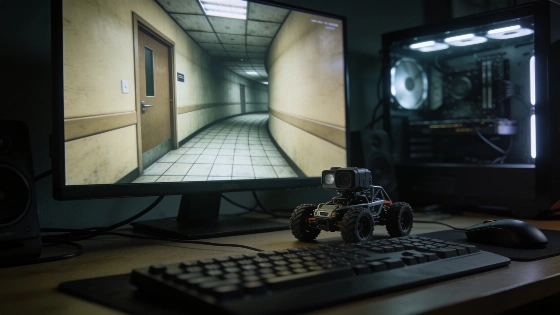
Players move through beige corridors, empty offices and tiled passageways that loop back with small changes. Ceilings are too low. Proportions feel wrong. Familiar spaces become hard to trust.
There are no creatures chasing the player. The pressure comes from isolation, repetition and the sense that the architecture is changing around them.
The RC car is the main tool. Its camera can travel under doors, through vents and into spaces the player cannot reach directly. Players use that view to inspect hidden areas, recover objects, trigger mechanisms and find a way forward. GamesPress and Game*Spark both describe the camera-equipped vehicle as the game's defining tool, especially when the player needs to reach inaccessible spaces.
Progress depends on understanding how the rooms relate to one another. It is not always about finding a key or following a waypoint. Spatial puzzles and timing-based challenges ask players to notice what has changed, work out how areas connect and use the car's limited reach carefully.
Grief in five stages
Each chapter draws on the five stages of the Kübler-Ross model: denial, anger, bargaining, depression and acceptance. The game does not present those stages only through exposition. They shape the environments, puzzles and atmosphere. The building itself becomes the main way the story is told.
Game*Spark and DarkZero also connect the structure of the world to those five stages.
That approach gives Tape 101 a more focused identity than a standard survival-horror release. The supplied material makes no confirmed claims about combat systems, enemy encounters or an action-heavy structure. The tension comes instead from uncertain spaces and the gap between what a room appears to be and what it lets the player do.
The team kept refining navigation, puzzle design, pacing and environmental storytelling after the public Steam playtest and Steam Next Fest demo. That history helps explain the launch, but it is not independent performance testing or a review of the finished build.
What players receive
Tape 101: Liminal Descent is a PC release on Steam with five emotionally themed stages, an RC car camera, environmental investigation and puzzles built around space and timing. The launch trailer is available online. The Steam page provides the route to purchase the game.
The supplied announcement does not give a completion time, system requirements, accessibility features, controller support or performance targets.
The price and discount are clear. The available information is narrower than a technical review, though. No frame-rate figures, resolution targets, hardware requirements or measured loading results have been provided. There is no basis for judging optimisation before independent testing.
Players can judge the premise and feature set now. They cannot judge the game's final performance from the announcement alone.
Double H Productions previously worked on That Gate Again on itch.io. Tape 101 is the team's larger documented project after three years of development.
Its strongest idea is also its clearest promise. Grief is not background lore. It becomes a navigation problem expressed through architecture. That makes the game a specific indie horror release for players who prefer atmosphere and environmental puzzles to combat. The lack of technical evidence means the Steam version should be judged on the finished game, not on the marketing language around it.
Spatial horror asks players to notice changes that an action game might show through enemies or interface prompts. Tape 101: Liminal Descent puts that work on observation. The RC car turns perspective into a tool for solving the environment.
On the evidence available, Double H Productions has delivered a focused psychological horror concept with a distinctive interaction at its center. The $9.99 launch is a clear proposition, though independent testing is still needed to establish how well the final PC version performs.