
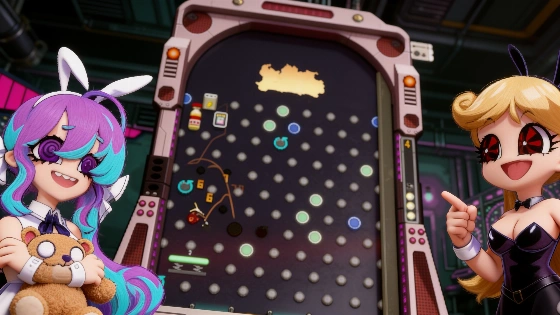
Kniv Studio has released the first Steam demo for High Roller Penny. The pachinko-inspired roguelike mixes risky pegboard builds, bunny girls and a fight to clear crushing debts.
High Roller Penny has opened its underground gambling den with a playable Steam demo. Every decision now comes down to a bouncing ball. Kniv Studio's pachinko-inspired roguelike went live on Steam on September 29, 2026. The demo adds new peg types, several ball variants and another bunny girl waiting at the end of a run. Famitsu and Denfaminicogamer both reported the launch that day.
A demo built around risk
The central loop is easy to understand and hard to control. Players drop a ball onto a pegboard. Physics, modifiers and carefully chosen upgrades then shape the run. The aim is to build a score high enough to escape the debt. Every peg hit adds points, but the board's layout and the tools collected between attempts decide much of the route.
The demo adds big balls, small balls, bowling balls and bouncy balls. Some pegs multiply a ball. Others trigger a shockwave or send it flying. The blue peg adds another variable for players trying to turn an uncertain drop into a profitable run. These are part of the demo's expanded set of ball and peg types, not just cosmetic changes.
That mix gives High Roller Penny an identity beyond a visual pachinko imitation. The ball is both the attack and the gamble. Players can shape a build, but they cannot fully control the ball's final journey across the board. MonsterVine and Denfaminicogamer describe the demo as an early look at this risk-and-physics design.
Debt drives the structure
The full game casts players as a pathetic debtor. Penny kidnaps them and takes them to Yami-pachi, a shady underground gambling den for death games. Penny is chasing the High Roller, a special condition that pits two bunny girls against each other. The player's immediate goal is simpler: win enough to clear the debt instead of dying in the attempt.
Players earn tickets during runs. They can spend them on stronger pegs and balls, then look for more effective combinations and synergies. The economy does not offer a safe progression ladder. High Roller Penny lets players sell tickets, pegs and balls. A quick recovery can leave them without the tools they need for the next attempt.
The available information does not say how long the demo lasts or how much of the wider campaign it includes. It confirms a single-player format, a 2D presentation and a roguelike structure. The final release date and price are still listed as TBC. Japanese coverage also lists support for Japanese, English, Simplified Chinese, Traditional Chinese and Korean.
What remains unknown
High Roller Penny is targeting PC via Steam. Kniv Studio has not given a confirmed launch date for the complete game. The studio released a trailer with the demo, but the supplied announcement gives no performance targets, system requirements or resolution information. It also includes no independent testing. The demo is an introduction, not proof of the game's final technical quality. Noisy Pixel and MonsterVine likewise say the demo is already available on Steam without giving a release date for the full game.
There is no confirmed pricing or edition information either. That gap matters because the game's premise revolves around buying, selling and risking resources. The announcement only describes the in-game ticket economy. It does not say whether the finished product will include any additional monetisation.
For readers following small-scale releases with a strong mechanical hook, the project sits between arcade physics and build-driven roguelikes. Kniv Studio's debut title was STARDUST: Wish of Witch, released in May 2026, as described in the studio's earlier release. High Roller Penny moves the studio towards a tighter score-chasing format.
High Roller Penny's first demo deserves attention because the risk is part of the play. It is not just decoration. The release gives players a direct look at the pegboard, ball and ticket systems. It does not answer the bigger questions about content, balance, price or final release timing. For now, the demo is a chance to test the core loop, not proof that the finished game is a known quantity.