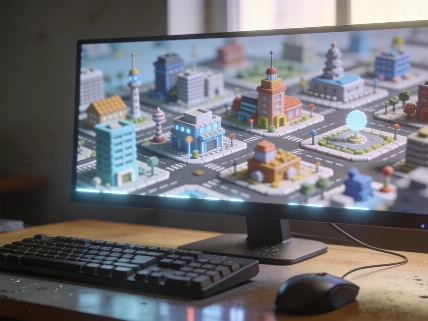

MicroProse and Hilkojj Interactive released Car Park Capital on Steam Early Access on October 9, 2026. Players build a profitable parking empire while traffic and public opinion become resources to manage.
On October 9, 2026, players took control of a deliberately absurd urban machine where homes and trees stand between Big Auto and a profitable sea of asphalt. Public transport faces the same pressure. MicroProse and Hilkojj Interactive announced the launch alongside a new Early Access Launch Trailer.
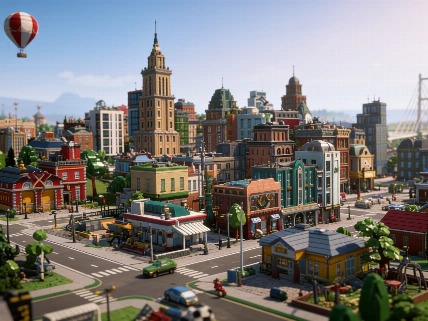
The official Steam store listing identifies Car Park Capital as an Early Access title. It also tags the game as City Builder, Isometric and Capitalism, with each label pointing toward the same design. Players acquire land, choose how each plot will be used and expand private parking infrastructure. Rock Paper Shotgun describes the project as a management-city-builder hybrid rather than a conventional traffic puzzle.
Parking Takes Priority
The premise is blunt by design.
Players buy land and remove existing buildings before deciding how aggressively to replace useful urban space with parking. The game frames eviction as a business opportunity. Demolition becomes another revenue decision, while cars can be sold and people are charged to store them.
Car Park Capital connects the automotive economy to the rest of its management model. More cars create demand for parking. Big Box Stores and Diners attract additional traffic, which supports further construction and new services. Rock Paper Shotgun describes the wider objective as transforming cities built around green living and public transport into car-dependent suburban environments.
The design draws on 1990s management games, including Bullfrog's Theme Park and Theme Hospital. It redirects that familiar language toward car dependency and the commercialisation of urban space. Expanding services and balancing demand remain part of the appeal, while the business being optimised is deliberately uncomfortable.
Parking operations can also rise vertically. The game presents upward construction as a practical response to urban pressure, making more infrastructure for vehicles the recurring answer.
Systems Behind The Satire
Underneath the theme sits a real-time strategy and management simulation. Hundreds of citizens and vehicles interact through linked systems for traffic and production. Individual needs, public opinion and profitability also shape the simulation. Keeping those systems moving requires more than placing car parks and waiting for revenue.
Fuel becomes its own industrial chain. Players can drill for oil, move it to refineries and supply petrol stations. Vehicles must keep operating. Cars can also be manufactured for car vending machines, while other production lines cover plastic trees. Livestock and meat processing support drive-through food services.
Citizens need food and drinks. They also need fuel, amusement and toilets. Meeting those needs makes them more willing to spend on parking, petrol and cars. Drive-through facilities benefit as well. The Giant Toilet Drive-Thru turns the logic of never leaving the car into a literal destination.
Additional descriptions frame the game as an economic strategy in which parking capacity and car use directly support income from parking fees. The financial loop is clear: traffic becomes something the player is paid to produce.
Public opinion is another active resource. Statues and billboards can promote a pro-car message. Megaphone trucks push the same line through the streets, while citizens maintain individual thoughts and happiness levels. They also form opinions about the changing environment.
Demolition and tree removal can trigger protests. Paving and oil extraction can do the same. Demonstrators may obstruct businesses and influence other citizens. Riot police are available as a response.
Urban Conflict Included
Public transport is treated as a rival system rather than a neutral service. Trains and underground networks can move people efficiently, so the player is encouraged to persuade passengers that private vehicles offer real freedom. The argument is deliberately backwards, but its management consequences are concrete. Transport choices affect movement, demand and public sentiment.
Environmental damage receives the same treatment. Plastic trees can be manufactured and placed to reduce Civil Unrest when dead trees upset citizens. The solution is intentionally hollow. Car Park Capital uses familiar management-game rewards to expose contradictions in the policies it asks players to implement.
The Stat-o-matic provides the administrative view of the experiment. Players can track income and spending while monitoring citizen Needs. Other performance figures appear as the wider network develops in real time. The game does not hide its preference for rising graphs, even when those graphs represent the conversion of liveable space into automotive infrastructure.
What Early Access Means
The confirmed release is an Early Access launch rather than a finished full release. Car Park Capital became available on Steam on October 9, 2026. The supplied announcement gives no final release date or price. It also provides no roadmap, system requirements or performance targets, and does not confirm whether the current build represents the complete scope of the planned simulation.
The new launch trailer introduces the game's premise and systems. It does not provide independent proof of final quality. No measured frame rates or resolution targets are supplied. Hardware requirements and reviewer testing are absent as well. The available information establishes the design direction, but it cannot show how smoothly the simulation performs in every situation or how its systems will develop during Early Access.
MicroProse brings a publishing history that includes Civilization. Its catalogue also includes X-COM and Falcon. Hilkojj Interactive is the independent studio led by Hilko Janssen in the Netherlands.
Janssen developed a proprietary Game Engine and Rendering Engine for retro-styled games inspired by the 1990s and 2000s. Car Park Capital also uses an automatic Blender to 2D spritesheet pipeline created for the project.
The Original Soundtrack is planned for a later release and is composed by Kent Kercher. His previous work includes Star Wars: Galaxy's Edge and Justice League. It also includes Watchmen and The Grinch.
Early access matters here because the game's appeal depends on how its interconnected systems behave. A simulation can contain traffic and production mechanics without making them meaningfully interact. Public opinion is another test of that interaction.
Car Park Capital has a clear premise and a sharp set of tools, but its release status leaves the quality of those connections unverified. The available information does not establish the game as a finished urban-planning simulation.