
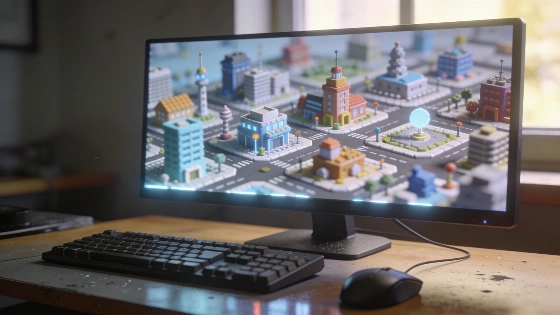
Solo developer 7Seven Studios will launch Town of Tinysville on Steam on 4 December 2026. Its free demo is already live ahead of Steam Next Fest, which runs from 19 to 26 October, and puts deckbuilding and city planning at the center.
Town of Tinysville puts a city builder inside a roguelike deckbuilding structure. 7Seven Studios will launch it on Steam on 4 December 2026. The solo-developed debut uses compact maps where each building affects the area around it. Poor planning can bring a run to an end. COGconnected described the project as a deck-building roguelike city-builder and reported on 28 September 2026 that its demo was already live on Steam ahead of the October festival.
Launch details
7Seven Studios founder Louis DiGiorno III announced the game. He is an independent developer based in New York. Town of Tinysville is confirmed for Steam, and its free demo is available ahead of Steam Next Fest as part of the October event. Steam Next Fest: October 2026 is scheduled to run from 19 to 26 October, according to published festival timings. Players can also wishlist the game before the full release.
The demo appeared after Valve's reported 28 September submission deadline for the October event. Participating demos therefore had to be submitted for review before the festival began. Valve's Steamworks guidance, as summarized in coverage of Next Fest policies, also allows participating games to keep their demos live after the event. The existing demo may therefore remain useful beyond the festival, although the article does not say how long 7Seven Studios plans to keep it available.
The available information does not include a price, system requirements, additional platform versions or confirmed launch-day technical targets. It also does not show that the trailer represents final retail performance. For now, the announcement is mainly about the release date and the game's features, not performance.
For players considering the demo, the offer is simple. They can test the main placement and deckbuilding systems before the December launch, without a confirmed commitment to the complete game. The demo is already live before the 19 to 26 October Next Fest window, so interested players do not need to wait for the festival to try its central idea.
Small maps, big decisions
Town of Tinysville replaces the combat found in many deckbuilders with an economic city-planning challenge. Buildings interact with nearby structures. Players must arrange them in combinations that increase coin production. Upgrades and placement choices are tied together. A useful card may be weak on its own but valuable beside the right buildings.
The town layout changes with each run. Players must adapt instead of following one permanent blueprint. The developer calls the maps small, but limited space and changing constraints raise the stakes. An inefficient arrangement can end the current attempt.
That design gives the game a tougher identity than a standard city builder. There is no indication of a large open world or a long-form urban simulation. The loop is tighter. Players draw options, place structures, build synergies and decide whether the next improvement will strengthen the town or expose its weak points.
Cards, landmarks and replayability
Cards provide permanent progression. Players discover and use them during runs, then keep them unlocked for future attempts. This expands the collection and lets players revisit earlier strategies with more tools. Failure can still be useful, but each individual town remains under pressure.
Landmarks provide much of the system's variety. Town of Tinysville includes 120 landmarks, 24 buildings and 36 laws. Their effects can copy another landmark, trigger buildings again or prevent a run from ending. The game presents these mechanics as routes toward an Endless Mode rather than as isolated bonuses.
The full version contains 12 towns with distinct shapes and constraints, seven difficulty levels and 254 total cards to discover. It also includes an Endless Mode and a soundtrack by 7Seven Studios credited to Louis DiGiorno. A range of building combinations is meant to support repeated runs. Those numbers create a substantial ruleset for a debut project, but they do not prove how varied or balanced the finished runs will feel.
The focus on permanent unlocks and randomized layouts puts the game closer to a repeatable strategy puzzle than a traditional settlement sandbox. Readers who follow small independent projects may recognize the appeal of a compact, system-led game. The recent release coverage of another indie roguelite shows how different these games can be when their main loops focus on farming, combat or planning.
What remains unknown
The announcement confirms the release date and the game's main systems. The early demo gives players a way to examine the concept before launch. Several buying questions remain unanswered. There is no confirmed price, published PC specification or detail about save systems, accessibility options or controller support. The Steam listing and demo should give a better sense of presentation and usability, but a demo cannot show the final balance of all 254 cards.
There is also no independent evidence yet about performance, loading times or stability. The trailer may show the intended look and structure, but edited footage cannot show how consistently the final game will handle dense landmark interactions or late-run layouts. Those questions matter in a strategy game built around readable information and precise decisions.
7Seven Studios has chosen a focused idea for its first release: make every square matter, then rebuild the town with a different hand of cards. That gives players a clearer reason to pay attention than broad promises of limitless city building. The confirmed feature set points to a specific tactical loop. Town of Tinysville deserves attention as a compact and unusually structured Steam release. Its demo and final build will need to show that the depth suggested by its card count holds up across repeated play.
In a roguelike deckbuilder, permanent unlocks expand the options available across attempts. Procedural generation changes the conditions of each individual run. That combination can create variety, but it can also expose balance problems if some card interactions consistently dominate weaker choices. Town of Tinysville has the ingredients for a thoughtful planning game rather than a conventional city simulator. The December launch will show whether its small maps create meaningful decisions or merely restrict the player.