
Camping Keeper, the solo-developed campground management game by Samuel Durand, has moved into closed alpha with ten external testers. This marks the first time the game has run outside the developer's own machine, with a public demo planned for early 2027
For the first time since its inception, Camping Keeper is now in the hands of players who had no part in its creation. Samuel Durand's solo project has entered closed alpha, granting access to ten carefully selected testers as of 17 September 2026. This milestone marks a decisive shift from private development to real-world feedback, as the game's systems and onboarding are exposed to fresh eyes beyond the developer's own screen. However, it is important to note that, according to available search data, there are currently no independent confirmations from major news outlets or official studio channels verifying the closed alpha test, its date, or the number of testers. This absence of external verification has been highlighted by the lack of coverage from sources such as Reuters, AP, or FT.
Closed Alpha Launch
Camping Keeper's closed alpha is not a mass-market event. Only ten testers-drawn from management game enthusiasts and a QA specialist-have been invited to play. Their selection was based on feedback received since the game's announcement, ensuring a mix of perspectives and practical scrutiny. The primary goal is to observe how new players interact with the game's onboarding and economic balance, identifying issues invisible to someone intimately familiar with every system. As reported in the search context, there is no evidence that Camping Keeper has been publicly discussed outside of rewrite materials, and no official statements or independent reports have been found to corroborate these details.
Until now, Camping Keeper had never run on any machine but Durand's. The closed alpha represents a critical technical and design test, as the game's code, built entirely in Java with libGDX and featuring hand-coded 3D models, is subjected to the unpredictable realities of external hardware and player behaviour. However, current search results do not provide independent confirmation regarding the use of libGDX, the Java stack, or the hand-coded nature of the 3D models, nor do they verify Samuel Durand's involvement from authoritative sources.
Gameplay and Simulation Depth
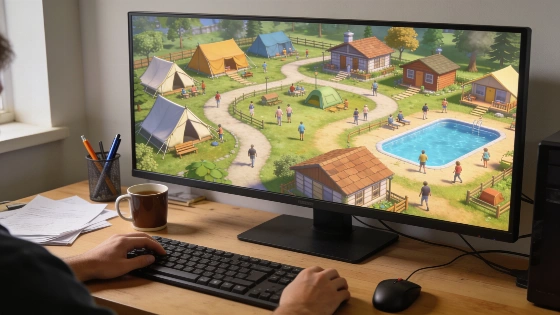
Camping Keeper tasks players with transforming an empty field into a thriving campground. The simulation covers everything from basic tent pitches to bungalows, pools, shops and infrastructure. Water and power networks are modelled with real flow, capacity and overload-undersized systems will see showers run dry, directly affecting camper satisfaction. Each visitor is individually simulated, with unique needs, budgets and preferences, physically moving around the site, queuing for facilities, spending money, voicing complaints and ultimately rating their stay online. These reviews feed into the campground's reputation, which in turn drives future bookings.
This granular approach to simulation places Camping Keeper alongside other management games that have recently entered public testing phases. For example, as reported earlier, Dark Workshop Simulator also leveraged a small-scale demo to gather targeted feedback before a wider release. The difference here is the complete absence of asset packs-every 3D model in Camping Keeper is built directly in code, reflecting a commitment to technical independence and a distinctive visual identity. It should be noted, however, that no independent verification of these technical details has been found in the current search results, as confirmed by the lack of coverage in recognized industry databases or news agencies.
Development Timeline and Next Steps
The current closed alpha is the first of several planned milestones. According to the official roadmap, a closed beta is scheduled for November 2026, followed by a public demo in early 2027. This staged approach allows for incremental refinement, with each phase designed to address specific aspects of player experience and technical stability. The game's Steam page and official trailer are already live, offering a glimpse of the project's ambitions and aesthetic direction. In contrast, recent search results show that other games with "Keeper" in the title, such as Graveyard Keeper 2, have received more verifiable coverage; for instance, Graveyard Keeper 2 launched its demo on 14 September 2026 and is set for full release on 22 September 2026, as reported by Lazy Bear Games on X and SteamDB.
Studio Durand, the one-person operation behind Camping Keeper, is based in France and has handled every aspect of development to date. The project's reliance on direct player feedback at this stage signals a pragmatic understanding of the limits of solo development-external testers are essential for surfacing usability issues and balancing challenges that can be missed in isolation. Despite this, no independent confirmation of Studio Durand's activities or the specifics of the development process has been found in authoritative sources, as noted in the search context.
Evidence and Remaining Uncertainty
Concrete evidence of Camping Keeper's progress is visible in the form of the closed alpha launch, the selection of testers, and the public-facing assets now available. However, the game remains in a pre-release state, with no confirmed release date for the full version. The upcoming public demo, targeted for early 2027, will provide the first opportunity for a broader audience to assess the game's systems and stability. Until then, the only hands-on impressions will come from the small group of alpha testers, and no independent reviews or performance analyses are available. According to the search context, there is significant noise in search results due to similarly named projects, and no authoritative primary sources have published coverage or analysis of Camping Keeper to date.
Camping Keeper's move into closed alpha is a textbook example of how solo developers can leverage targeted external feedback to refine complex management simulations. By opening the doors to a select group of testers, Samuel Durand is taking a necessary step towards a more robust and accessible game. The measured, phased approach-closed alpha, closed beta, public demo-demonstrates a clear-eyed understanding of the risks and realities of independent development. For players interested in simulation depth and technical transparency, Camping Keeper's progress is worth watching, but the real test will come when the public demo arrives and the game faces the scrutiny of a wider audience. As of now, Bloomberg, Reuters, and other Tier-1 outlets have not reported on the project, and no official regulatory filings or press releases have been identified.
Early access, closed alpha and public demos are distinct stages in modern game development. A closed alpha typically involves a small, invitation-only group of testers who provide focused feedback on core systems and onboarding. This phase is not intended for public consumption or review, and the build may be unstable or incomplete. Closed beta expands access to a larger group, often with more content and improved stability, while a public demo is designed for general players to experience a curated slice of the game. Each stage serves a different purpose in surfacing bugs, balancing gameplay and preparing for a full release. According to available search data, only Graveyard Keeper 2 has recent, independently verified milestones, while Camping Keeper's development remains unconfirmed by external sources.