
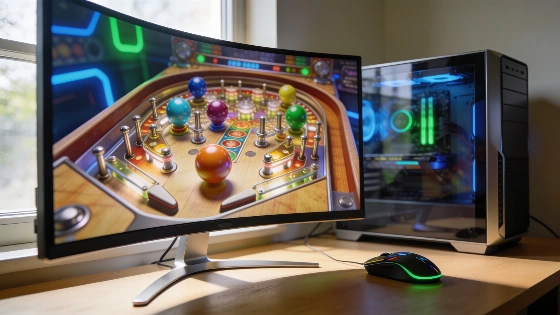
Void Pachinko, a new physics-based semi-idle game, is now available on Steam. Players can build custom pachinko boards, upgrade pins and balls, and restore a shattered village across five levels in a four-hour campaign
Void Pachinko has officially launched on Steam, offering players a blend of physics-driven mechanics and incremental progression. Developed by 2 Left Thumbs, the game invites users to construct their own pachinko boards, experiment with pin and ball upgrades, and unlock synergies to maximise point earnings. The experience is designed as a semi-idle title, allowing for both passive play and optional active control of the central barrier, catering to a range of playstyles.
Gameplay Structure and Features
The core gameplay loop revolves around releasing balls onto a customisable board, where upgraded pins and balls interact to generate combos and higher scores. Players can invest in a skill tree, unlocking incremental upgrades that further boost their earning potential. Each ball scored contributes to the restoration of a devastated village, tying progression to visible in-game changes. The campaign is structured across five distinct levels, each introducing new mechanics and narrative elements as players advance.
Void Pachinko supports multiple languages, including English, French, German, Japanese, Portuguese (Brazil), Russian, Simplified Chinese, and Spanish. The game is designed to be completed in approximately four hours, with a free demo available on Steam that covers the first level. Progress from the demo carries over to the full release, ensuring a seamless transition for early adopters.
Release Timing and Pricing
The full version of Void Pachinko is available now, with an official release date of 17 August 2026. The game is priced at $6.99 USD, and a 20% launch discount is being offered for a limited period. Both the main game and the demo can be accessed via their respective Steam pages. According to the developer, the campaign is designed to be completed in a single session for most players, though replayability may vary depending on individual playstyle and interest in optimising scores.
For those interested in further details or press materials, a presskit is available, and media enquiries can be directed to Graeme at 2 Left Thumbs. The game's release adds to a growing list of indie projects leveraging physics-based systems for unique gameplay, a trend also seen in other recent announcements such as the upcoming Neo Berlin 2087, which is set to arrive on multiple platforms in 2028 and was previously covered in our feature on future narrative-driven releases.
Technical and Platform Context
Void Pachinko is currently available exclusively on PC via Steam, with no indication of console or mobile versions at this stage. The game's physics simulation is central to its design, with real-time ball movement and collision behaviour forming the basis of both its challenge and its visual appeal. While the developer has not published detailed system requirements, the game's visual style and mechanics suggest it should be accessible to a wide range of modern PCs. There is no mention of advanced graphics features such as ray tracing or high refresh-rate support, and the focus remains on accessible, responsive gameplay rather than technical spectacle.
Players can expect a straightforward installation and immediate access upon purchase, with no account or subscription requirements beyond a standard Steam account. The inclusion of multiple language options and a demo with progress carryover may help broaden the game's appeal, particularly among players interested in incremental and simulation genres.
Physics-based games like Void Pachinko rely on real-time simulation to determine how objects interact within the game world. In this context, each ball's trajectory and collision with pins are calculated dynamically, resulting in unpredictable outcomes and emergent gameplay. This approach differs from scripted or pre-determined mechanics, offering a degree of replayability and player agency that can make each session feel distinct. However, the complexity of real-time physics can also introduce performance considerations, especially on lower-end hardware, though Void Pachinko's modest visual demands are likely to mitigate most issues for the majority of players.