
GameGrin still listed the demo among recent Steam releases on 5 October. Oduvan Games plans the full launch for 10 November, with five locations replacing the demo's two.
GameGrin's 6 October update still listed the build among recently released Steam demos as of 5 October 2026. Oduvan Games had released Potion-making: Path of the Alchemist on 30 September, with Beverlor named as publisher on Steam.
From Tabletop to PC
The project started with an offhand joke. After the updated Path of the Alchemist tabletop game came out, the Oduvan Games team played it together and floated the idea of bringing it to PC. The joke survived. The studio later secured funding and reached an agreement with the tabletop publisher, turning the idea into an official digital adaptation.
That background matters. This is a direct move from the tabletop game's central systems into a digital format, with the PC version handling much of the manual preparation and bookkeeping that board games require.
Oduvan Games spent more than a year building prototypes and running playtests before releasing the demo. The public build proves that the project is playable. It does not establish the final balance or the complete launch package.
Independent coverage confirms the demo, the Oduvan Games and Beverlor developer-publisher pairing, and its Steam availability. It provides no additional confirmed information about the financing or the rights agreement. The full version's specifications also remain undisclosed.
Recipes Become Weapons
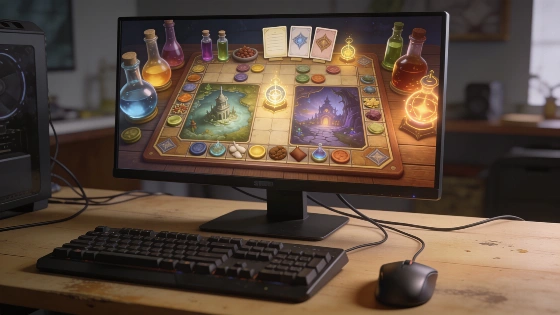
Potion-making: Path of the Alchemist turns a competitive board game into a digital strategy title. Players take the role of alchemists racing toward three Places of Power. They gather ingredients and combine them through linked recipes to create potions and other escalating forms of magical craft, including elixirs, essences, powders and magical creatures.
Steam classifies the project as an indie strategy game and uses the tags PvP, Tutorial and Board Game. Those labels match its competitive structure and its tabletop roots.
The shared table creates the sharpest conflict. A creation made by one player remains available to others, so a carefully assembled potion can become the missing component in an opponent's next recipe. Spells can disrupt those plans. Magical talismans give players another way to swing a match before a rival reaches the required Places of Power.
Progress depends on increasingly valuable combinations, yet the public pool lets opponents exploit work already completed. Efficiency and disruption therefore sit on the same track.
The digital version handles scoring and recipe combinations automatically. Spell effects are automated as well. Animations and an interactive board replace much of the physical administration without removing the shared-resource rules that define the tabletop game.
What the Demo Includes
The demo includes a guided tutorial, single-player matches against AI opponents and online multiplayer with friends or other players. It offers two locations: the Library of Five Worlds and the Floating Islands. Together they provide an early look at how the digital board presents the alchemists' race, while the wider launch package remains reserved for the full release.
At the time of GameGrin's coverage, the demo held a 100% positive rating on Steam based on 33 user reviews. That is a small early sample, not a verdict on the finished game. It does record the first public response to the available build.
The demo is also scheduled to appear during Steam Next Fest: October 2026, which runs from 19 to 26 October. The event gives players a chance to try the adaptation before launch. It also puts the studio's explanation of the tabletop rules in front of people outside its own playtesting process.
Oduvan Games has not announced pricing or technical requirements. No additional platform versions have been confirmed in the supplied information. Steam is the confirmed storefront, while the confirmed multiplayer options are single-player AI matches and online play.
Cross-play remains unconfirmed. So do progression details and offline functionality. The demo's presence on PC does not establish any of those features.
The fantasy setting adds its own mythology to the competitive framework. The Great Alchemist is said to have created the Primordial Tree through the Philosopher's Stone. Alexander Fulcanelli's forbidden spell damaged that balance, froze lands and caused magical creatures to disappear. New alchemists are called upon to restore the flame of life by reaching the three Places of Power.
Launch Plans
The full version is scheduled to arrive on Steam on 10 November 2026. It will expand the demo's two locations to five playable locations. Each one introduces variations on the Travel Board for single-player and online multiplayer matches.
Oduvan Games is also exploring further competitive features, including tournament leaderboards for future updates. The wording matters. These features are under consideration, not confirmed launch content, and should not be treated as promised day-one additions.
For players unfamiliar with the tabletop series, the demo is the strongest evidence currently available. It shows whether the recipe chains are readable and whether shared access creates meaningful tactical pressure. It also shows how automated rules affect the original game's competitive edge.
The demo cannot establish how the five-location release will be balanced. It also cannot show how future competitive systems will work.
Another Steam demo built around a distinctive physical or social game loop provides a useful comparison. Digital launches depend heavily on how quickly their core idea becomes understandable to a new audience. Potion-making: Path of the Alchemist puts that test in front of players by exposing its rules rather than hiding them behind a cinematic presentation.
In a digital board game, a recipe chain links dependent actions that turn basic resources into more valuable results. Automation removes the need to track every calculation by hand, but shared creations can still be claimed by an opponent. The available evidence confirms the demo as a PC adaptation of a 20-year-old tabletop property, while the November release and five-location structure remain untested.