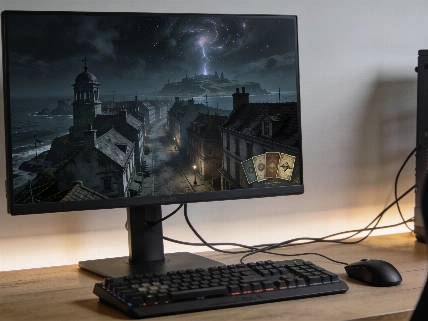

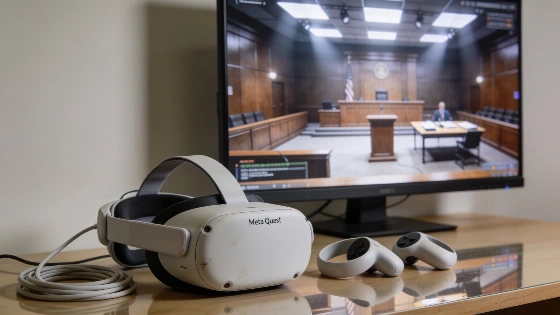
Amata K.K. will bring Phoenix Wright: Ace Attorney - Dual Destinies to Meta Quest 3, Quest 3S and Meta VR Glasses in 2027. The VR version will use voice commands, hand tracking and three-dimensional courtroom investigations.
Phoenix Wright is taking his first case into virtual reality. Amata K.K. has announced Phoenix Wright: Ace Attorney - Dual Destinies VR for Meta Quest and Meta VR Glasses in 2027 under an official licence agreement with CAPCOM CO., LTD. The announcement includes a teaser website and trailer, but the exact launch date and price have not been confirmed. Anime News Network independently identifies Amata Games as the developer and confirms that CAPCOM has officially licensed the project.
A first VR case
The project adapts the 2013 Nintendo 3DS release for Meta's VR hardware. It is not a new numbered entry. Meta has confirmed the game for Meta Quest 3, Meta Quest 3S and Meta VR Glasses. The platform list points to a release built for Meta's newer headset and glasses ecosystem. Quest Pro and Quest 2 have not been included in the available official announcement details.
Amata K.K. describes the game as a single-player courtroom battle and narrative adventure with more than 15 hours of playtime. Japanese, English, French, German, Korean, Traditional Chinese and Simplified Chinese are planned. Downloadable content is also planned. Anime News Network confirms that seven languages are listed for the project. These details describe the planned package, not a completed product. The 2027 window is still the only release timing supplied.
Evidence in the courtroom
The VR version moves the series' central confrontations into a three-dimensional courtroom. Players are expected to inspect suspicious witnesses and evidence at close range. They will then present contradictions in front of those witnesses. The game promises a more physical version of the familiar courtroom structure. Meta describes it as an adaptation in which players investigate 3D locations and present evidence through gestures and voice activation.
Controls will support conventional controllers, voice commands and hand-tracked gestures. Meta says the project was created from the ground up for hand interaction. Meta VR Glasses use controller-free interaction, while the Quest version supports controllers. Players will be able to call out witnesses and present evidence with their own hands. They can also use the voice command "Objection!!" Investigations are built around examining 3D crime scenes from different angles.
A trailer can show the intended shape of a VR experience. It cannot prove how consistently that experience works during a full case. The teaser site and trailer are the available announcement evidence. Performance, comfort options, accessibility settings and the final balance between control methods have not been detailed.
Phoenix Wright returns
Dual Destinies follows Phoenix Wright's return to legal practice after eight years. Apollo Justice and Athena Cykes join him as the team faces a legal system described as being in a dark age. In that system, winning has replaced the search for truth. Meta's description specifically presents players as Phoenix Wright, Apollo Justice and Athena Cykes. Investigations and courtroom evidence presentation are built around gestures and voice commands. The damaged courtroom opening and episodic case structure remain central to the story framework supplied for the VR adaptation.
Amata K.K. is building the conversion around observation and deduction rather than action. Players will search for contradictions, examine evidence and follow a story driven by twists and emotional stakes. NGB recently covered another Tokyo Game Show 2026 announcement in an earlier report. This project offers a very different kind of interaction by placing the courtroom around the user.
What remains unknown
Amata K.K. has confirmed its developer role, the licensed CAPCOM connection, the supported Meta hardware and the 2027 release window. Meta's Connect 2026 announcements name Meta Quest 3, Meta Quest 3S and Meta VR Glasses. The available confirmations do not establish a specific date, price or final store availability beyond the listed Meta platform information. The planned downloadable content has no announced scope or pricing. No technical performance targets have been supplied.
The announcement also does not say whether the game will support features such as cross-buy, save transfer, comfort presets or accessibility options. Those omissions are not evidence of a problem. They are practical details for a VR release and should remain separate from the confirmed feature list. Until Amata K.K. provides a launch date and more footage from a representative build, the clearest conclusion is that Dual Destinies has a credible VR conversion plan, not a fully documented final product.
In VR, hand tracking means the headset and its sensors must interpret the player's physical gestures while keeping virtual objects aligned with movement. That is different from displaying a traditional game on a larger screen. Investigation and evidence presentation depend on reliable interaction as well as narrative design. Phoenix Wright: Ace Attorney - Dual Destinies VR has a focused chance to make its courtroom mechanics feel genuinely present. For now, its 2027 announcement confirms the direction and platform plan, not the finished experience.