
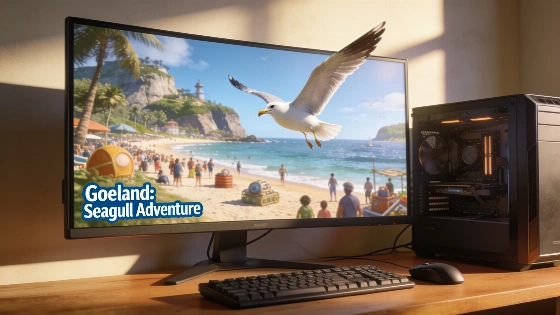
Maarti Games has officially revealed Goeland: Seagull Adventure, a sandbox title in development for PC and targeting a Q4 2026 launch. The game invites players to cause chaos or lend a wing as a mischievous seagull in an open world
French indie studio Maarti Games has announced Goeland: Seagull Adventure, a sandbox game currently in development for PC and scheduled for release in the final quarter of 2026. The announcement was accompanied by a new trailer, offering a first look at the game's open world and its blend of playful mischief and community interaction. The project is being developed in Montréal, Canada, and is partially funded by the Canada Media Fund.
Gameplay and Core Features
Goeland: Seagull Adventure places players in control of a seagull that has just escaped from a veterinary clinic. The game's open world is designed to allow for both helpful and disruptive playstyles. Players can choose to assist local residents by retrieving lost items and returning balloons, or embrace chaos by dropping objects-or less savoury surprises-on unsuspecting beachgoers. The island setting features a reactive crowd system, with non-player characters responding dynamically to the player's actions.
Mechanically, the game promises a variety of activities, from tug-of-war over food to unconventional mini-games such as tic-tac-toe with unexpected twists. Exploration is encouraged, with secrets to uncover and environmental mysteries to investigate, including a storyline involving pollution affecting the island's ecosystem. The developers highlight that each play session can unfold differently, with no fixed path or outcome.
Trailer Evidence and Genre Context
The debut trailer showcases a mix of in-game footage and edited sequences, focusing on the seagull's ability to interact with the environment and NPCs. While the trailer does not confirm final gameplay quality or performance, it establishes the game's tone and core mechanics. The approach is reminiscent of other animal-driven sandbox titles such as Untitled Goose Game, but with a focus on aerial movement and a broader range of player-driven chaos.
Goeland: Seagull Adventure is positioned as a single-player experience, with no mention of multiplayer or online features at this stage. The game's structure appears to prioritise emergent gameplay and replayability, with the island's systems designed to react to player choices. For readers interested in the wider trend of physics-driven sandbox games, a recent NGB article on Human Fall Flat's anniversary update provides additional context on the genre's evolution.
Release Timing and Platform Details
Maarti Games has confirmed that Goeland: Seagull Adventure is targeting a Q4 2026 release window on PC via Steam. No other platforms have been announced, and there is no indication of console versions or early access plans at this time. The studio encourages players to wishlist the game on Steam and follow official social channels for future updates. The announcement does not specify minimum or recommended PC requirements, nor does it detail pricing or edition structure.
The game is being developed by a small team led by Bryan Martinet, with a stated focus on accessible and time-respectful gameplay. Funding support from the Canada Media Fund suggests a degree of financial stability for the project, but as with many indie titles, timelines and features may evolve as development progresses. No information has been provided regarding localisation, accessibility options, or post-launch support.
In sandbox games like Goeland: Seagull Adventure, a reactive crowd system refers to non-player characters that respond dynamically to the player's actions, rather than following fixed routines. This design aims to create a more believable and engaging world, where player choices can lead to unpredictable outcomes. Such systems often rely on procedural behaviour and event triggers, allowing for emergent gameplay that differs from one session to the next. However, the complexity of these systems can also introduce technical challenges, particularly in maintaining performance and avoiding unintended behaviour as the world reacts to player-driven chaos.