

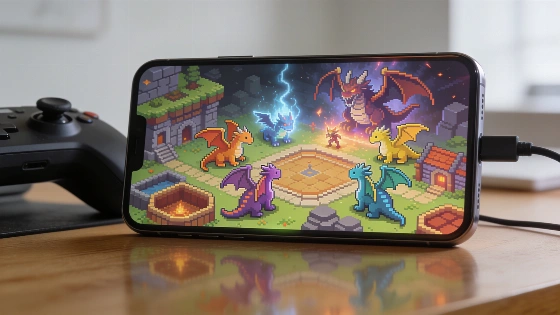
Highbrow's Dragon Village 3 links dragon breeding to elemental turn-based battles, village management, real-time PvP raids and World Boss encounters on iOS, Android and PC.
Collecting dragons is only the start in Dragon Village 3. Highbrow's latest game connects breeding to team building, then adds a personal village, real-time PvP, Raids and World Boss battles. The result is a broader game than a simple creature-raising title. It is already available on mobile platforms, and its official Google Play PC storefront listing confirms PC access.
Breeding drives progression
Players take the role of rookie Tamers. They can control ancient artefacts and command dragons. The story starts with an exploration of the creatures, then grows into a wider conflict involving their secrets and the fate of the world. That setup supports a collection system based on discovery rather than a fixed starter roster.
Dragons come from eggs that players acquire and hatch. The Altar of Life is where the roster gets more interesting. Two hatched dragons can be paired to create a new species. One example is the Firetail, which can come from combining a Fire Dragon with a Wind Dragon. More pairings open as the collection grows. Some results may offer stronger potential or dual-element affinities.
Dragons also move through visible life stages, from eggs to hatchlings and then adults. Adult dragons unlock Ultimate Skills. Higher-rarity additions get their own summoning and skill animations. Hatching and breeding take time, but that delay gives the collection a steady rhythm. Players acquire an egg, wait for the result, then decide whether the new dragon belongs in the next battle team. The official Taiwanese launch announcement describes these systems as part of a collection RPG built around hatching, breeding and village-building.
Elemental team building
Combat teams can contain up to three dragons. Each dragon has standard attacks and active skills. An Ultimate Skill becomes available after the dragon reaches adulthood. The rules are easy to follow, but elemental match-ups provide the main tactical layer. Single-element and dual-element dragons can change a team's value. A weaker creature may beat a stronger opponent if its affinity gives it the right counter.
This link between breeding and combat is Dragon Village 3's clearest design choice. A newly discovered species is more than another collection entry. It can fill a missing role or answer a difficult elemental encounter. Team order matters too. So does the timing of defensive choices, especially when protecting a main damage dealer matters more than using every attack at once.
The competitive mode adds another prediction game. In one real-time PvP format, opposing teams stay hidden during selection. Choosing three powerful dragons without thinking about counters can leave a player exposed. A flexible roster matters more than a single high-powered line-up, at least in the battles described for the mode.
Village and multiplayer modes
The village provides resources for developing dragons. It also opens new facilities as the Tamer level rises. Elemental habitats, experience-crop fields and decorative structures support progression and customisation. Dragons remain visible in the settlement. Feeding and caring for them gives players something quieter to do between fights, instead of turning the village into a separate resource menu.
Building has a mechanical purpose as well. Players can visit other Tamers for ideas. Certain structure combinations unlock NPC partners and additional facilities. Village design therefore has a longer-term goal beyond filling empty space with decorations.
Raids focus on bosses with several phases. Their forms, abilities and mechanics change during an encounter. Some bosses reward specialised counters, so players have a reason to raise a wider roster instead of relying on one dominant team.
World Boss battles put ten dragons against one enemy in real time. Players must interrupt a devastating ritual by activating their remaining Ultimate Skills. A successful interruption creates a temporary 200% damage window. Timing becomes central to the final score.
Progression without a rush
Dragon Village 3 also includes Guild Battles, dungeons, gathering activities and limited-time events. Summoning tickets and gems are distributed regularly. Casual players can use them to move through the story and build a dependable core squad without immediately chasing the highest possible power level.
Legendary dragons still depend on luck or careful resource planning. Pity counts and mileage points carry over instead of resetting. That makes long-term summoning less punishing for players who prefer to grow their roster gradually.
The game remains a free download on the Apple App Store and Google Play. More dragons and content are planned through regular updates. The official Taiwanese announcement lists iOS and Google Play availability and notes support for Traditional Chinese.
Dragon Village 3 is still receiving support after launch. According to the official Highbrow/Withhive community, a live patch was released on September 23, 2026. Another Dragon Village 3 update was scheduled for September 30. The same notice acknowledged a bug in the Rapport tutorial. Players could get stuck because they did not have enough fruit. The live patch addressed the issue.
The game's central numbers show how its combat is structured. Standard battles use teams of up to three dragons. World Boss encounters expand the field to ten. A successful ritual interruption opens a 200% damage window. These are not performance measurements or progression guarantees. They describe the tactical structure of the game's combat modes.
Access is not limited to phones and tablets. The official Google Play PC listing confirms a PC version of Dragon Village 3. It records an update on May 27, 2026, giving players another supported platform alongside the mobile releases.
Highbrow has also taken the launch outside the game. Gamer.com.tw reported that the company organised a Taiwan campaign using 100 buses across Greater Taipei from September 24 through October 23, 2026. Highbrow linked the promotion to Dragon Village 3's collecting theme. QR codes on the buses marked the official Taiwanese launch and encouraged player engagement.
Coverage has continued too. Pocket Gamer published an updated beginner's guide on September 25, 2026. Along with the scheduled updates and launch promotion, that guide points to an ongoing player-facing ecosystem rather than a release that ended at launch.
Dragon Village 3 works best when its systems support one another. Breeding expands the collection. Elemental battles give each discovery a practical use. Village facilities help maintain the roster. PvP and boss encounters then test that preparation outside the story. With pixel-art creatures, slow-burn collection and team tactics, Highbrow has built a mobile game that depends on connected systems instead of collecting for its own sake.
Elemental affinity works as a matchup system. A dragon's value depends on its opponent and on the rest of the team supporting it, not only on raw strength. That is why dual-element breeding and roster variety matter more than chasing the rarest creature. Dragon Village 3 is best understood as a strategy-led raising game with a village layer, rather than as a dragon catalogue. That gives its free-to-play structure a reason to keep players experimenting.