
Developer Rafoli has announced CRACK a 1-4 player co-op adventure where players work together to crack open a giant egg in a secretive lab The game is set for release on Steam on 26 October and features community-driven development
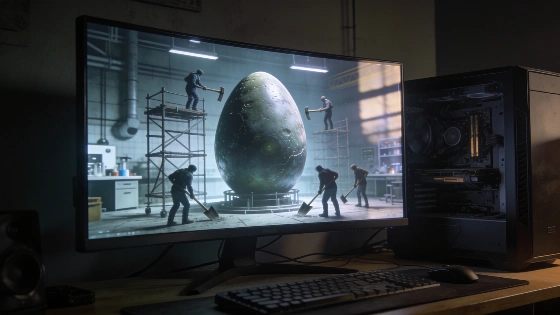
In a laboratory where the only certainty is the presence of a colossal, unexplained egg, CRACK is set to challenge players' curiosity and teamwork when it launches on Steam on 26 October 2026. According to GamesPress, the game is officially described as a cooperative experience for 1-4 players, with the central task being as simple as it is bizarre: break open the egg, follow the rules, and do not ask questions that are not part of the job. The project is developed by Rafoli, who has made the game's Steam page available for wishlisting ahead of release.
The Announcement and Release Date
CRACK was announced by Rafoli on social media, confirming a global Steam release for 26 October 2026. The game's premise is direct-players, alone or with up to three friends, are assigned to crack open a giant egg using an expanding arsenal of tools. The official announcement, as cited by GamesPress, uses the phrase: "your job is simple: crack it open, with up to 3 friends," confirming the cooperative format for up to four participants. The announcement was accompanied by a trailer, which will be publicly available after the embargo lifts, offering a first look at the game's peculiar laboratory setting and the mysterious egg at its centre.
Players can wishlist CRACK now on Steam, with the developer encouraging the community to follow ongoing development updates across TikTok, Instagram, and YouTube. According to independent coverage by NetEase, Rafoli has been sharing the development process publicly on these platforms since the project's inception. The game's release date places it in a competitive autumn window, but its unusual concept sets it apart from more conventional co-op titles. For those tracking the indie release calendar, this follows a trend of experimental projects, as reported earlier with other genre-defying launches.
Gameplay Structure and Laboratory Setting
CRACK's gameplay revolves around a division of labour inside a secretive laboratory. Players are tasked with peeling, chiselling, and blasting their way through the egg's shell, unlocking new tools and upgrades as they progress. According to NetEase, the game features a variety of instruments such as pickaxes, hammers, and explosives, emphasizing teamwork and role specialization within the lab environment. The laboratory is not just a backdrop-it is an active participant, with management issuing instructions and reminders through public announcement speakers. Secret rooms and tool upgrades are gradually revealed, but the game maintains a strict professional tone: breaks are mandatory, and the assignment is to be respected.
Each player can specialise: one might focus on peeling the egg, another on converting shells into in-game earnings, while a third automates production or constructs scaffolding to reach higher sections. The egg itself is not passive-it reacts to player actions, introducing an element of unpredictability and encouraging careful, coordinated teamwork. The game's structure is designed to reward both methodical play and creative problem-solving, with the laboratory's mysteries providing a persistent sense of unease. GamesPress describes CRACK as a "1-4 player co-op incremental adventure," highlighting the incremental progression through unlocking new tools and upgrades as a core gameplay loop.
Community-Driven Development and Player Involvement
From its inception, CRACK has been developed in public, with Rafoli documenting progress and actively soliciting ideas from the community. NetEase reports that this approach has led to some of the game's more eccentric features being shaped by player suggestions, blurring the line between developer and audience. The developer describes the project as having started from a joke about an unquestioned giant egg, but the result is a co-op experience that is as much about the process as the outcome.
Players are encouraged to participate in the ongoing development conversation, with the possibility that their ideas could be implemented in future updates. This open development model is increasingly common among indie studios, but CRACK's focus on secrecy, professionalism, and the unknown gives it a distinctive identity within the genre.
What Remains Unanswered
Despite the detailed description of gameplay and setting, CRACK's central mystery remains intact: what is inside the egg, and why are players forbidden from asking? The laboratory's origins, the purpose of the assignment, and the true nature of the egg are all left deliberately unexplained. The game's communication style-management speaking only through speakers, mandatory breaks, and a strict adherence to protocol-reinforces the sense that players are participants in an experiment as much as a game.
With the release date set for 26 October 2026 and the trailer soon to be public, players will have to wait to discover how much of the mystery is revealed through play. Until then, the only certainty is the assignment: crack the egg, follow the rules, and do not ask questions that are not part of the job. CRACK's willingness to embrace ambiguity and player-driven development marks it as a project to watch in a season crowded with more conventional releases.
Co-op incremental games like CRACK rely on a structure where progress is shared among players, and each action contributes to a collective goal. Unlike traditional single-player adventures, these games often require careful coordination and communication, with each player's role affecting the group's efficiency. The incremental aspect means that upgrades and automation gradually accelerate progress, but the core challenge remains in how players divide tasks and respond to unexpected developments. This design philosophy encourages replayability and experimentation, especially when the game's world reacts dynamically to player choices. As confirmed by GamesPress and NetEase, CRACK's unique blend of cooperative incremental gameplay and mysterious narrative sets it apart in the indie scene.