
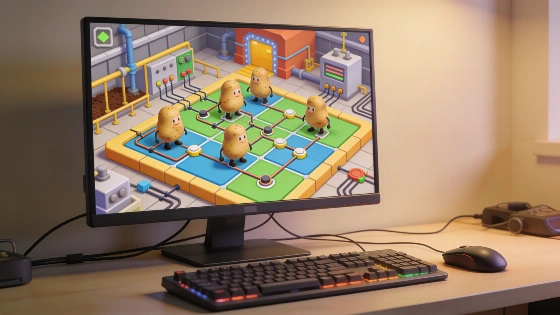
Bunian Games has released a free demo for CPU Computing Potatoes Unlimited on Steam, letting players try 11 puzzles and bonus challenges before the full game's planned January 2027 launch
Steam's Programming Fest has delivered a rare opportunity for puzzle fans: CPU: Computing Potatoes Unlimited is now available to try in a free demo, giving players direct access to its programming-based challenges months before the full release. According to SteamDB, the demo was officially registered as a separate application (App ID 5147340) and released on September 10, 2026, with Bunian Games listed as both developer and publisher. This move puts Bunian Games' logic-driven factory simulator in the hands of the public, not just as a marketing beat but as a concrete test of its core mechanics and player appeal. The demo is free and, as noted by SteamDB, is excluded from Steam Family Sharing due to its content type, confirming its real and unrestricted release.
Demo Content and Features
The demo, now live on Steam, includes 11 main puzzles and three unlockable bonus challenges. Players are tasked with programming potato workers to process numbers using a punch-in instruction system, all within a factory that mimics the logic of a computer processor-a gameplay description that matches the official SteamDB entry. The puzzles are open-ended, encouraging optimisation and experimentation rather than single-solution thinking. An optimisation histogram is included to visualise solution efficiency, and the first track of the official soundtrack is available within the demo build. SteamHunters has already begun tracking achievements for the demo, indicating integration with Steam's achievement system and the presence of a dedicated page for the demo on the platform.
Unlike many puzzle games that restrict early access to a handful of levels, CPU: Computing Potatoes Unlimited's demo offers a substantial slice of content. The inclusion of bonus challenges and performance tracking tools signals a focus on replayability and player-driven improvement, rather than simply showcasing surface mechanics. According to CogConnected, the demo's release has been independently reported and discussed in the wider gaming press, further confirming its availability and the growing interest in the title.
Full Game Roadmap
Bunian Games has confirmed that the full release, scheduled for January 2027, will expand the puzzle count to over 40. A Playground mode is planned, featuring Steam Workshop integration for user-generated content, alongside a complete original soundtrack and leaderboards for competitive optimisation. The studio, based in Amman, Jordan, consists of just two developers, and positions itself as a specialist in programming and logic-puzzle games. The Steam page provides further details and access to both the demo and trailers, including a gameplay-focused announcement trailer and a separate animated demo trailer. Notably, SteamDB records show that the demo was first added to the Steam system on August 20, 2026, several weeks before its public release, highlighting a period of internal testing and preparation.
For players tracking the rise of indie puzzle games on Steam, this release follows a trend of hands-on demos and early access launches, as seen with other recent titles reported earlier on NGB. The approach allows studios to gather feedback and build a player base ahead of full launch, while also exposing the game's systems to public scrutiny. Community interest is further evidenced by a Reddit post dated September 14, 2026, where players discuss the demo's availability and share first impressions, providing independent confirmation of the demo's release and reception.
Evidence and Remaining Questions
All evidence so far comes from the playable demo and official trailers. The gameplay trailer demonstrates the punch-in programming mechanic and the factory's processor-inspired layout, but does not confirm the full range of puzzle complexity or the depth of later-game content. The animated demo trailer offers a stylised overview but is not representative of in-game visuals. No independent technical analysis or review access has been reported at this stage, and performance on lower-end hardware remains untested by third parties. According to SteamDB and SteamHunters, the demo's technical integration with Steam is robust, but broader performance metrics are not yet available.
While the demo's inclusion of optimisation histograms and bonus challenges is a positive sign, the absence of Playground mode and Steam Workshop integration in the current build means that the most ambitious features are still unproven. The January 2027 release window is official, but as with all indie projects, timelines can shift if development hurdles arise. Bunian Games' track record is limited, so long-term support and update cadence remain open questions. CogConnected and SteamDB both confirm the demo's release and current status, but further independent reviews will be needed to assess the game's full potential.
Player Impact and Editorial Assessment
For players interested in programming logic and optimisation, CPU: Computing Potatoes Unlimited's demo is a rare chance to test a game's core systems before launch. The decision to release a substantial demo, rather than a token teaser, demonstrates a willingness to let the mechanics speak for themselves and to invite meaningful feedback. However, the absence of Playground mode and user-generated content in the demo means that the game's long-term appeal is still theoretical. Until the full release delivers on its promises, the demo stands as both a proof of concept and a challenge to the studio: can Bunian Games sustain player interest beyond the initial novelty? The next months will reveal whether this indie experiment can carve out a lasting place in the crowded puzzle genre, or whether its clever premise is best experienced in short bursts.
Programming puzzle games like CPU: Computing Potatoes Unlimited rely on clear logic systems and player-driven optimisation. In these games, players write or assemble instructions to manipulate data, often within constraints that reward efficiency and creativity. Optimisation histograms, as seen in this demo, provide visual feedback on how a player's solution compares to possible alternatives, encouraging iteration and mastery. The genre's appeal lies in its blend of problem-solving and technical thinking, but its success depends on the depth of its systems and the quality of its challenge curve.